-
"As we know from extensive science fiction research, one day we will be equipped with unobtrusive and tastefully designed technology that will project before our eyes a heads-up display of information related to whatever real-life scene we’re looking at. That level of augmented reality, however, is a ways down the road, and unfortunately that road is likely to be strewn with the broken bodies of early adopters."
Alex Soojung-Kim Pang, Ph.D.
I study people, technology, and the worlds they make
Month: August 2009 (page 1 of 5)
From the Good Morning Silicon Valley blog:
Simple common sense should tell us that trying to text while driving is as stupid and dangerous as trying to crochet. We shouldn’t need a bunch of studies calculating and quantifying the risk to goad us into a response, but if that’s what it takes, here’s the latest. A Virginia Tech study that outfitted the cabs of long-haul trucks with video cameras found that when the drivers were texting, their collision risk was 23 times greater than when they had their attention on the road — a figure far higher than the estimates coming out of lab research and a rate by far more dangerous than other driving distractions. And at the University of Utah, research on college students using driving simulators showed texting raised the crash risk by eight times. The variance in the figures is beside the point. “You’re off the charts in both cases,” said Utah professor David Strayer. “It’s crazy to be doing it.”
And the heck of it is, people already know that and they keep doing it anyway.
This is a near-perfect example of how most humans are geniuses at rationalization: yes, I know it's dangerous, but I'll be careful and do it just this time, because I really need to let the office know where that file is. Oh wait, they've got another question. Well, it would be more dangerous to wait and put the phone down, so I'll just- dammit, can't the kids find anything by themselves? Okay, now I'll make up for it by really focusing on the road.
It's also a nice example of the kinds of dissonance created when we take practices and technologies designed for one use context, and move it into another- a phenomenon that mobile technologies makes increasingly common. It was hard to take a Macintosh SE or IBM PC Junior on the road; a smartphone, on the other hand, is a perfect storm of transportable, always-on, and just usable enough when you're doing other things to be dangerous.
[To the tune of Jean Sibelius, "Tapiola, Op. 112," from the album Finlandia/Tone Poems (I give it 2 stars).]
Matt Yglesias on the problem with identifying bubbles:
Even when you’re pretty sure you’ve identified one, this gives you almost no insight into questions of timing. Consequently, it’s quite difficult to use your insight to go make tons of money. And that in turn makes the bubbles more severe, since the skeptics are basically out on the sidelines.
And in the reputational economy of analysts the consequences are even worse. If you go along with the herd and then predict a problem a month before it arises, then you strike everyone as prescient. But if you start warning about something and then it doesn’t happen, and then you keep nagging people, and then you keep complaining about how nobody’s listening to you, you start getting dismissed as a crank. And when you’re proven right, you’re still that crank nobody wants to listen to. You don’t get hailed as a hero. But Ben Bernanke who made very mainstream mistakes and then pivoted adroitly once the bill came due does.
Timing is everything, and ironically but the problem of knowing when to sound an alarm is itself a prime example of the problem of timing.
[To the tune of David Gray, “Slow Motion,” from the album Live at Massey Hall (December 2, 2007) (I give it 3 stars).]
“All men are liable to error; and most men are, in many points, by passion or interests, under temptation to it.” (John Locke)
[To the tune of David Gray, “Fugitive,” from the album Fugitive - Single (I give it 4 stars).]
Via Overcoming Bias, another great example of how we respond to unconscious cues, this time in placebos:
[Lilly scientist William] Potter discovered, however, that geographic location alone could determine whether a drug bested placebo or crossed the futility boundary. By the late ’90s, for example, the classic antianxiety drug diazepam (also known as Valium) was still beating placebo in France and Belgium. But when the drug was tested in the US, it was likely to fail. Conversely, Prozac performed better in America than it did in western Europe and South Africa. It was an unsettling prospect: FDA approval could hinge on where the company chose to conduct a trial. …
As Potter and his colleagues [also] discovered that ratings by trial observers varied significantly from one testing site to another. It was like finding out that the judges in a tight race each had a different idea about the placement of the finish line. … The placebo response is highly sensitive to cultural differences. Anthropologist Daniel Moerman found that Germans are high placebo reactors in trials of ulcer drugs but low in trials of drugs for hypertension—an undertreated condition in Germany, where many people pop pills for herzinsuffizienz, or low blood pressure. Moreover, a pill’s shape, size, branding, and price all influence its effects on the body. Soothing blue capsules make more effective tranquilizers than angry red ones, except among Italian men, for whom the color blue is associated with their national soccer team—Forza Azzurri!
[To the tune of Miles Davis Quintet, “Teo’s Bag (alternate take),” from the album The Complete Columbia Studio Sessions, 1965-68 (I give it 1 stars).]
My friend (and, if the editors smile upon our efforts, soon-to-be coauthor) Darlene Cavalier pointed me to an article by Dan Schultz on Media Shift Idea Lab about what journalists can learn from the citizen scientist movement. Essentially, the piece argues that citizen and professional scientists have developed a division of labor and authority that journalists could emulate.
Two points.
First, this isn’t the first time that such a division of labor and authority has emerged in science. In the early nineteenth century, the scientific world in Britain (and in somewhat similar measure the U.S.) consisted of a small elite that ran the Royal Society, was considered (or considered itself) competent to deal with big theoretical issues, and set the agenda for science; and a mass of local observers, ranging from country parson and skilled artisans to teachers and soldiers. Members of this second group could become notable for masterful knowledge of a narrow slice of the universe- the natural history of their parish, the habits of large mammals in eastern Kenya, Jupiter’s moons, etc.- and could make meaningful contributions to science within their area of expertise.
These boundaries weren’t entirely hard and fast- there was always the possibility of either moving up from the category of local expert to scientific eminence (Charles Darwin might never have made the jump to the second category if he hadn’t gone on the Beagle), or reaching beyond one’s place- but people generally (to use an outmoded phrase) knew their place.
The existence of these well-understood boundaries, and the resulting symbiotic relationship that is emerging between professional and citizen scientists, gives Schultz hope that journalists could create something similar:
If you buy my claim that scientists and journalists all care about informational integrity and the quest for truth, then several things can be extrapolated:
- If professional journalists take the lead by clearly defining expectations, explaining best practices, and implementing an accessible infrastructure, then amateurs can contribute without disrupting the industry.
- If amateur journalists do a good job of covering a smaller scope of topics or areas (e.g. the hyperlocal), then professionals can focus on the deeper, otherwise inaccessible issues.
- Professional journalists are responsible for creating and maintaining the citizen network if they want it to meet their standards.
- Citizen networks need more than a host. In order to reach full potential, they need to be explicitly empowered through tools and guidance.
- A symbiotic relationship between the professional, the amateur, and the crowd is not just possible, it’s socially optimal.
And there we have it: If the journalism industry can create an infrastructure that allows amateurs to contribute reliable information, then professionals will be able to dedicate more resources to epic reporting. If local papers can find the capacity to set up and empower meaningful citizen networks, they will establish a major foothold in the evolving domains of community and information.
But this leads to my second point, which is that this division of labor and authority is exactly what some bloggers argue is unnecessary today- and which is more at issue in contentious scientific fields like climate change (or alas, evolution) than it should be. Proponents of intelligent design, for example, have quite brilliantly appropriated the language of democracy to suggest that people should be allowed to make up their own minds about evolution, and could easily make a similar appeal using the citizen science movement. Journalists, it seems to me, are likely to have a tougher time differentiating what they do from “citizen journalists,” particularly in an age in which the boundary between reporting and opinion has been eroded, and the professional status of journalists is under assault.
Still, it’s a good model to follow.
[To the tune of Miles Davis, “So What,” from the album Columbia Years 1955-85 (Disc 2): Originals/Moods (I give it 4 stars).]
This is fascinating:
Gravity affects not just our bodies and our behaviours, but our very thoughts. That’s the fascinating conclusion of a new study which shows that simply holding a heavy object can affect the way we think. A simple heavy clipboard can makes issues seem weightier - when holding one, volunteers think of situations as more important and they invest more mental effort in dealing with abstract issues.
In a variety of languages, from English to Dutch to Chinese, importance is often described by words pertaining to weight. We speak of ‘heavy news, ‘weighty matters’ and ‘light entertainment’. We weigh up the value of evidence, we lend weight to arguments with facts, and our opinions carry weight if we wield influence and authority. These are more than just quirks of language - they reflect real links that our minds make between weight and importance.
Nils Jostmann from the University of Amsterdam demonstrated the link between weight and importance through a quartet of experiments. In each one, a different set of volunteers held a clipboard that either weighed 1.5 pounds or 2.3 pounds….
Jostmann reasons that the link between weight and importance is rooted in our early childhood experiences, when we rapidly learn that heavy objects require more effort to deal with, not just in terms of strength but planning too. Our brain relies on these concrete physical experiences when it represents more abstract concepts, like importance. The two are then joined, so that physical experiences can affect abstract thought.
This is far from the first study that has supported this “theory of embodied cognition”. Jostmann’s explanation can also account for why thinking clean thoughts can soften moral judgments and why immoral thoughts trigger a need for physical cleanliness. It’s why warming our hands can make us socially warmer, why social exclusion literally feels cold.
[To the tune of Miles Davis Quintet, “Riot,” from the album The Complete Columbia Studio Sessions, 1965-68 (I give it 2 stars).]
-
Views: Criminal Incompetence - Inside Higher Ed"I have been reading Diego Gambetta's new book Codes of the Underworld: How Criminals Communicate, just published by Princeton University Press. The author, a professor of sociology at Oxford University, notes that senior convicts in Folsom State Penitentiary, including its "honorable" tattoo artists, strongly discourage young and unmarked felons from getting inked. Gambetta, who has also published a study of the Sicilian Mafia, takes a transnational approach in his new book. He cites a report on the attitude found within a South African prison: 'Facial tattoos are the ultimate abandonment of all hope of a life outside.' "
Via Crooked Timber, this Inside Higher Ed review of Diego Gambetta’s Codes of the Underworld: How Criminals Communicate that has a great comparison of projected incompetence among mafiosi, who according Gambetta, cheerfully “let the professionals and the entrepreneurs take care of the actual business operations” and admit that they’re only good at shaking people down, and a certain brand of italian academic, the “baroni (barons) who oversee the selection committees involved in Italian academic promotions.”
While some fields are more meritocratic than others, the struggle for advancement often involves a great deal of horse trading. “The barons operate on the basis of a pact of reciprocity, which requires a lot of trust, for debts are repaid years later. Debts and credits are even passed on from generation to generation within a professor’s ‘lineage,’ and professors close to retirement are excluded from the current deals, for they will not be around long enough to return favors.”
The most powerful figures in this system, says Gambetta, tend to be the least intellectually distinguished. They do little research, publish rarely, and at best are derivative of “some foreign author on whose fame they hope to ride…. Also, and this is what is the most intriguing, they do not try to hide their weakness. One has the impression that they almost flaunt it in personal contacts.”
Well, one also has the impression that the author is here on the verge of writing a satirical novel. But a friend who is interested in both the politics and academic life of Italy tells me that this account is all too recognizably accurate, in some fields anyway. Gambetta calls the system “an academic kakistocracy, or government by the worst,” which is definitely an expression I can see catching on.
[To the tune of Thievery Corporation Feat. Sister Nancy, “Originality,” from the album Versions (I give it 1 stars).]
Via Overcoming Bias, I found this great review by Philip Tetlock in The National Interest of several futures-related books I’ve been meaning to read: Ian Bremmer and Preston Keat’s The Fat Tail; Bruce Bueno de Mesquita’s The Predictioneer’s Game; and George Friedman’s The Next 100 Years. (My ongoing near-obsession with Tetlock’s work is well-documented in this blog, and in other things I’ve written.)
It’s one of those reviews that, yes, talks about the books, but really treats the books as a launching-point for talking about other cool things (in other words, it’s the kind of book review I like to write).
In this case, there are two things that jump out at me. (Incidentally, Tetlock’s verdict is that Frieman and Bremer/Keat aren’t very good, but de Mesquita is worth grappling with.) The first is that it includes a nice precis of one of the core arguments of his 2005 book, Expert Political Judgment.
A good deal of research indicates that some ways of thinking (“cognitive styles”) do translate into somewhat more correct forecasts. When we score the accuracy of thousands of predictions from hundreds of experts across dozens of countries over twenty years, we find the best forecasters tend to be modest about their forecasting skills, eclectic in their ideological and theoretical tastes, and self-critical in their analytical styles. Borrowing from philosopher Isaiah Berlin, I call them foxes—experts who know many things and are not finicky about where they get good ideas. Paraphrasing Deng Xiaoping, they do not care if the cat is white or black, only that it catches mice.
Contrast this with what I call hedgehogs—experts who know one big thing from which likely future trends can be more or less directly deduced. The big thing might be any of a variety of theories: Marxist faith in the class struggle as the driver of history or libertarian faith in the self-correcting power of free markets, or a realist faith in balance-of-power politics or an institutionalist faith in the capacity of the international community to make world politics less ruthlessly anarchic, or an eco-doomster faith in the impending apocalypse or a techno-boomster faith in our ability to make cost-effective substitutes for pretty much anything we might run out of.
What experts think—where they fall along the Left-Right spectrum—is a weak predictor of accuracy. But how experts think is a surprisingly consistent predictor. Relative to foxes who are less encumbered by loyalties to an all-encompassing worldview, hedgehogs offer bolder forecasts and, although they hit occasional grand slams, they strike out a lot and wind up with decidedly poorer batting averages.
The second is his suggestion about how to begin to deal with a problem that’s central to the field: that we don’t really keep track of either how accurate our forecasts are (which is something that clients always want to know).
How then can we produce the most accurate forecasts? The answer is not obvious: right now all we can say confidently is that no one can be 100 percent confident about which approach would win if we were to run a series of level-playing-field forecasting tournaments stretching out to, say, 2020.
But if the market seems largely indifferent to our plight, who might rescue us? There is one potential savior on the horizon: a big institutional purchaser of forecasting services that has the financial clout and technical-support staff ready to run forecasting tournaments that would shed light on the relative performance of competing approaches—a big player that also has powerful incentives to discover superior analytical strategies, for even small improvements in its prediction accuracy can translate into billions of dollars and millions of lives saved. And that player is the Office of the Director of National Intelligence.
Unfortunately, although intelligence agencies have been heavy buyers of forecasting services, they have not used their massive purchasing power to their full advantage. They have allowed the diverse interest groups in the intelligence community to choose freely from private-sector forecasting products. On the one hand, this is commendably open-minded. On the other hand, there has been no integrative effort to assess the relative value added of each product. Indeed, intelligence agencies seem as allergic as private-sector forecasters to being held accountable to public accuracy metrics.
I like Tetlock’s suggestion, but personally I think it’s just as important to try to assess how useful our work is- whether it be delivered in the form of roadmaps, scenarios, provocative pieces in industry magazines, or wherever- as well as how correct we are. Futurists constantly argue that utility is the real metric by which we should be judged: IFTF president emeritus Bob Johansen likes to say that you should never trust anyone who says they can predict the future, especially if they’re from California. But too often we don’t have the fine detail about how our work gets used by clients, how it informs their decisions, and how we can adjust it to be more useful.
This is a shame, because the field is capable of evolving very quickly: when I was at IFTF, we developed all kinds of new tools and media for both doing research and communicating our ideas. But we tended to have to do so with less rigorous knowledge about how our earlier work had been received, interpreted, analyzed, etc. than I would have liked.
The other problem that the “you can be useful without being right” argument is it leaves unresolved two big questions.
First, how wrong can be you be and still be useful? Can you get the future totally wrong and still be useful to clients? To put it less provocatively, could a good futurist take a forecast or scenario that was essentially generated at random, and create something useful for clients? Is there a point at which error overwhelms utility? (Or conversely, could it be that erroneous forecasts are actually more useful? More counterintuitive things have proved true in our time.)
Second, who’s responsible for the work being useful? In one sense, clients are always responsible for generating most of the value from a prediction: if I say something exactly right about the future and a client doesn’t act on it, then they’ve lost the opportunity to create value from my prediction. If utility can be divorced from reality (or future reality), does the burden shift entirely to the client (or reader) to find or create the value in a (right or wrong) forecast?
As a once and kind-of current academic, I’m certainly sympathetic to the idea that our work is like teaching: we can help guide our students or clients, offer access our craft and wisdom, but they have to do the work of understanding and learning themselves. But at the very least, I’d like to better understand how these social contracts are supposed to work, and better yet, understand how they actually do function- to have a better sense of how clients create utility from our work, and what we can do to increase that utility.
[To the tune of John Coltrane, “A Love Supreme, Part I - Acknowledgement,” from the album The Classic Quartet - The Complete Impulse! Studio Recordings (I give it 4 stars).]
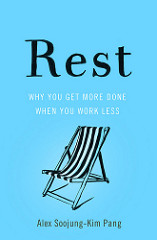
Add REST: WHY YOU GET MORE DONE WHEN YOU WORK LESS to your Goodreads shelf

My books on Goodreads
 The Distraction Addiction: Getting the Information You Need and the Communication You Want, Without Enraging Your Family, Annoying Your Colleagues, and Destroying Your Soul
reviews: 78
ratings: 316 (avg rating 3.53)
ratings: 316 (avg rating 3.53)


