-
"Without consistent feedback, it can be tough for a motorist to answer the question: How good a driver am I? In fact, we tend to be overconfident behind the wheel. A risky driver may go for a long time without a crash out of sheer luck, the same way a person who eats a terrible diet may live for decades with no apparent ill effects. And when external feedback does arrive, in the form of a honk or comment from another driver, it is likely to spark cognitive dissonance (What's their problem?) in the face of our carefully constructed sense of self-esteem."
Alex Soojung-Kim Pang, Ph.D.
I study people, technology, and the worlds they make
Month: November 2009 (page 1 of 4)
From James Parker’s piece on Nora Ephron and Nancy Meyers in the December issue of The Atlantic:
Sitting at the bar with his ex-wife, his round a little glass something or other, Baldwin… is florid, potent, gloatingly and inflatedly masculine, like a genie who came out of a bottle of aftershave.
[To the tune of Radiohead, “Airbag,” from the album Radiohead in Berlin (I give it 2 stars).]
Catching up with some reading, I came across Peggy Orenstein’s New York Times essay “Growing Up on Facebook,” published earlier this year. One of its themes, about the conflict between leaving behind old social circles and reinventing yourself on one hand, and remaining in ambient contact with your old social life on the other, resonated especially strongly:
As a survivor of the postage-stamp era, college was my big chance to doff the roles in my family and community that I had outgrown, to reinvent myself, to get busy with the embarrassing, exciting, muddy, wonderful work of creating an adult identity. Can you really do that with your 450 closest friends watching, all tweeting to affirm ad nauseam your present self? The cultural icons of my girlhood were Mary Richards of “The Mary Tyler Moore Show” and Ann Marie of “That Girl,” both redoubtably trying to make it on their own. Following their lead, I swaggered off to college (where I knew no one) without looking back; then to New York City (where I knew no one) and San Francisco (ditto), refining my adult self with each jump. Certainly, I kept in touch with a few true old friends, but no one else — thank goodness! — witnessed the many and spectacular metaphoric pratfalls I took on the way to figuring out what and whom I wanted to be. Even now, time bends when I open Facebook: it’s as if I’m simultaneously a journalist/wife/mother in Berkeley and the goofy girl I left behind in Minneapolis. Could I have become the former if I had remained perpetually tethered to the latter?
This also connects with an excellent William Deresiewicz essay about social media’s erosion of solitude- which in our pop psychology moments we tend to equate with loneliness and want to banish, but which serves a tremendous psychic need. Humans are social creatures who seem to grow in equal parts through being with others and learning to be on their own- my children are currently both going through a phase in which they spend a non-trivial amount of time in their rooms- and Deresciewicz argues that solitude offers a chance (as Orenstein puts it) “to establish distance from their former selves, to clear space for introspection and transformation.”
[To the tune of Django Reinhardt, “Swing From Paris,” from the album The Best of DJango Reinhardt (I give it 2 stars).]
John Boudreau reports that “the Internet is reconnecting long-lost sweethearts,” while Scott Harris writes about Facebook as a time machine (gee, that sounds familiar).
Boudreau:
Not long ago, such rekindlings were largely relegated to once-a-decade school reunions, those awkward gatherings that tend to be more about sizing up past rivals than reconnecting with former sweethearts. But the Internet is now profoundly altering some people’s links to the past and sometimes upending their lives in unexpected ways. For some, the outcome is a blissful recoupling; for others, the reignited embers burn down the house….
[T]he Internet, and now social-networking sites such as MyLife.com. and Facebook, make relinking easier and more common. And people are doing it at a much younger age — instead of an uncomfortable phone call to her parents, all he has to do is do a Google search for her name.
Harris:
Many people tell of reuniting with cherished, long-lost friends, or reviving meaningful social circles that had frayed over the years. I’ve met a couple who were high school sweethearts but had been out of touch for 23 years. Now they credit Facebook for reconnecting them — and the romance is fully rekindled. …
It’s interesting how Facebook has connected a little social network of my high school friends — some close, some not so close. When I couldn’t find an address for a friend whose father had died, I contacted one of her classmates through Facebook. She had the e-mail address.
Why is that?
Unlike predecessors Friendster and MySpace, Facebook succeeded by creating a culture of authenticity — not a dodgy realm of alter egos, but a place where people feel comfortable showing off photos of their children to their friends.
I would say that it didn’t create that culture of authenticity: it set some initial conditions that allowed users to create it.
[To the tune of Django Reinhardt, “It Don’t Mean a Thing (If it Ain’t Got That Swing),” from the album The Best of DJango Reinhardt (I give it 1 stars).]
A pretty good New York Times article on people who spend a lot of time working in coffeeshops. My favorite: a matchmaker who works out of a “Nora Ephron-ish coffee shop in the West Village” rather than an office because it’s “easier to get people talking in a cafe.”
Essentially, cafes really have become cheap coworking space filled with cafe zombies.
[To the tune of Blur, “Coffee & TV,” from the album 13 (I give it 2 stars).]
For a while now, I’ve been thinking and writing about how Web 2.0 fits in the lives of people my age: how technology affects memory (especially how human and computer memories differ); how the omnipresence of the Web may affect our capacity to forget and grow and mature; and how Facebook serves as a kind of time machines. I’ve now started a Facebook group on “Digital Middle Age” around these subjects.
There’s an assumption that anyone over about 24, pretty much by definition, will find games, new media, and Web 2.0 to be a Strange Foreign Country. Partly this is an extension of the reigning assumption that only the young really “get it” when it comes to new technology. Witness Pamela Satran’s gently humorous pieces in More.com explaining how not to act old on Facebook and Twitter. (Okay, a magazine aimed at women over 40 is likely to play on age anxiety more than most; but easy way the articles take for granted that teenagers know the “right” way to behave (certainly the first time in human history we’ve assumed that!) is still pretty striking.)
But the articles overlook the fact that their readership grew up with PCs, spent thousands of hours in front of computer screens, and is perfectly familiar with the Web. My cohort is one that grew up with computers, but not with social media. I was in high school when the first personal computers appeared. I spent hours with my high school’s Apple II; I crunched the numbers for my senior thesis using Lotus 1-2-3; wrote my dissertation on a Mac; and got my first e-mail address when I was a postdoc. People my age have all the technical facility (I refuse to use the word literacy) necessary to rapidly take up services like Twitter and Facebook. There’s a good reason older users are the fastest-growing user populations in the Web 2.0 world.
But unlike the teenagers and college students are using these services, we have lives that have taken place offline, largely outside the gravity well of the Internet. These services aren’t just continuations of our current lives: they can reconnect us to people we haven’t been in touch with for twenty years. Watching myself and my friends online, I sometimes think I’m watching a collision of two very different kinds of social worlds. And if like me you’re seriously interested in the social impacts of new technologies, studying these kinds of collisions and transitional groups (like people my age) is a particularly valuable way to see how new technologies affect the way people work and play and socialize and think.
And while teenagers are an interesting subject because they’re reckless, extreme, irresponsible, and everyone worries about them- when you’re not certain they’re dead in a ditch, you’re yelling at them to get off your lawn- I think its safe to say that their parents have large amounts of disposable income, access to credit, a majority vote in household technology-related decision-making, etc.- all the things that ought to make them very interesting not just to academic geeks like me, but to advertisers and publishers. (We also have more to lose: drunken blog posts or sexting may be bad when you’re 19, but accidentally Tweeting trade secrets is a lot worse, if only because mortgages and parental responsibilities multiply the potential impact of big mistakes.)
So, as part of my ongoing effort to understand how media have affected this transitional generation, I’ve created the Facebook group. It’s open to everyone who’s in Facebook, and my hope is that it’ll help me better understand how social media function in the lives of people who already have lives. Does reconnecting with people from high school really matter? Does it change your life in some non-trivial way? I think it can, but data is not the plural of anecdote- especially when you just repeat the same anecdotes (your own) over and over.
Maybe there’s an interesting article here. Who knows. We’ll see what happens….
[To the tune of Daryl Hall & John Oates, “Out of Touch,” from the album Big Bam Boom (I give it 3 stars).]
Patrick Stewart- yes, that Patrick Stewart- has a harrowing but brilliantly-written piece in the Guardian about growing up with an abusive father:
One of the very last men to be evacuated from Dunkirk, his third stripe was chalked on to his uniform by an officer when no more senior NCOs were left alive. Parachuted into Crete and Italy, both times under fire, he fought at Monte Casino and was twice mentioned in dispatches. A fellow soldier once told me, “When your father marches on to the parade ground, the birds in the trees stop singing.”
In civilian life it was a different story. He was an angry, unhappy and frustrated man who was not able to control his emotions or his hands. As a child I witnessed his repeated violence against my mother, and the terror and misery he caused was such that, if I felt I could have succeeded, I would have killed him. If my mother had attempted it, I would have held him down.
Read the whole thing.
[To the tune of Cocteau Twins, “Pur,” from the album Four-Calendar Café (I give it 2 stars).]
It seemed like a while since I’d created the last one, and of course I had more complex, pressing things to do this evening, so I created a new banner for the blog. This one is from a September 2009 picture I took in London during my customary evening walk.
[To the tune of Fleetwood Mac, “Go Your Own Way,” from the album The Very Best Of Fleetwood Mac (Disc 1) (I give it 3 stars).]
I’ve long had an interest in robotic systems in scientific research. There’s been lots in this area in astronomy, with the growth of both remote and robotic observatories. Other scientists are developing robots for use in dangerous icy environments. But some of the most interesting work in this area is happening in ocean science, with everything from fixed sensor nets, to electronic tags on squid, and chemical tags in baby clownfish, to semi-autonomous thermal gliders.
So I was interested to see that the NSF has just awarded a $1 million grant to create automated explorers at much smaller scales. The grant will allow a team at Scripps
to design and deploy autonomous underwater explorers, or AUEs. AUEs will trace the fine details of oceanographic processes vital to tiny marine inhabitants.
While oceanographers have been skilled in detailing large-scale ocean processes, a need has emerged to zero in on functions unfolding at smaller scales. By defining localized currents, temperature, salinity, pressure and biological properties, AUEs will offer new and valuable information about a range of ocean phenomena.
“We’re seeing great success in the global use of ocean profiling floats to document large-scale circulation patterns and other physical and chemical attributes of the deep and open seas,” said Phillip Taylor of NSF’s division of ocean sciences. “These innovative AUEs will allow researchers to sample the environments of coastal regions as well, and to better understand how small organisms operate in the complex surroundings of the oceans.”
The miniature robots will aid in obtaining information needed for developing marine protected areas, determining critical nursery habitats for fish and other animals, tracking harmful algae blooms, and monitoring oil spills.
There’s a video on YouTube about the robotics and the future of ocean science, but be warned, it’s an hour long.
This seems like a technology that could be really cool, and not just because it pushes automated exploration to a new, smaller scale: AUEs that are very small are likely to become pretty cheap, which means that sooner or later they’ll be adopted, appropriated, or copied by amateur scientists (or citizen scientists, as some call them). Amateurs aren’t likely to tag dolphins or sharks, but an amateur naturalist living in Carmel or Cape May could pretty capably study the micro-environments of the beaches nearby, producing a cross between Gilbert White’s Natural History of Selborne and a more quantitative intensive area study.
[To the tune of Genesis, “Home by the Sea / Second Home by the Sea,” from the album Live at the Los Angeles Forum (October 16 1986) (I give it 3 stars).]
-
Ben Kafka - Faculty BioBen Kafka is a historian of Europe who studies the powers and failures of paperwork.
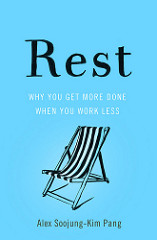
Add REST: WHY YOU GET MORE DONE WHEN YOU WORK LESS to your Goodreads shelf

My books on Goodreads
 The Distraction Addiction: Getting the Information You Need and the Communication You Want, Without Enraging Your Family, Annoying Your Colleagues, and Destroying Your Soul
reviews: 78
ratings: 316 (avg rating 3.53)
ratings: 316 (avg rating 3.53)


