-
The Trouble With Predictions: The “Negroponte Flip” 20 Years Later"As a futurist, I have respected the fact that the future is not only not what it used to be, but that specific predictions as to dates and market size can certainly come back to bite you."
-
FT.com / US / Economy & Fed - Soros to invest $50m in economic think-tank"George Soros, the fund manager, has pledged $50m to back a new think-tank with the mission of reconceiving the field of economics, which he describes as “a dogma whose time has passed”. The group, to be called the Institute of New Economic Thinking, will gather luminaries in the field of economics to reflect on the ideas that allowed the latest economic crisis to transpire and to bring new ideas to a profession that some argue has become too deeply entrenched in free-market ideology."
-
Nascent: Sensemaking in Multi-Fusion EnvironmentsIn brief a sensemaking system is one that, in contrast to a data warehousing solution, does something active with each piece of data as it is acquired, rather than only storing the data for later re-use. Identity disambiguation is a problem that these class of systems have been applied to in the past, however the new technique will be more generally applicable.
-
Rachel K. Hanig and Mark E. Henshaw, "Needed: A National Security Simulation Center," Studies in Intelligence 52:2The IC has responded to current challenges by trying to improve standard best practices; improving information-sharing; and promoting alternative analytical techniques. "A solution that fuses all three initiatives together into a single whole and that resolves the problem posed by the pressure for analytical timeliness would be ideal. We propose that one solution is, ironically, both widely known and little practiced by the IC, simulations."
-
Roger George, "Meeting 21st Century Transnational Challenges: Building a Global Intelligence Paradigm," Studies in Intelligence 51:3"The opportunity now exists to tap into a vastly larger amount of expertise than was previously available to US intelligence. However, this will require working from a very different paradigm from that which characterized much of our Cold War history. The key features of that traditional paradigm were: secrets; classified channels of information flows; a focus on a few hard targets… very limited contact with outside experts who were almost always US citizens; and focus on key facts and finished intelligence products. The new paradigm, in contrast, will focus on “open source” information and reach out to a wide variety of experts who are non-intelligence professionals drawn from different sectors and often non-Americans. As the 21st century is expected to be far less predictable and dynamic, the objective is to scan the horizon for emergent issues and so-called weak signals that are harbingers of futures for which few governments have begun preparing."
-
Carmen Medina and Rebecca Fisher, "Thinking About the Business of Intelligence," Studies in Intelligence 53:3“Why did economists not do a better job anticipating the crisis?” was the question everyone seemed to be asking as the global economy began to unravel last fall. The consensus seems to be that most economists not only failed to see the crisis coming but also were downright hostile to the few who argued that The Great Moderation—the era of economic stability brought about by modern banking system controls—wasn’t so great after all…. Anyone who has looked at his brokerage accounts or her retirement portfolio lately already “gets it” at the macro level. But what exactly happened on the cellular level to get us to where we ended up? And what can we, as intelligence professionals, learn from those events?
-
"Recently, I attended a small conference about using social tools for information sharing hosted at Johns Hopkins University and sponsored by the U.S. Intelligence Community (IC). Our hosts for three days were the Central Intelligence Agency’s (CIA) World Intelligence Review (WIRe) and the Director of National Intelligence’s (DNI) Intelligence Community Enterprise Services (ICES). They were able to bring together the people who build social tools, those who evangelize about them, and influential end users to have candid and open discussions about them."
Alex Soojung-Kim Pang, Ph.D.
I study people, technology, and the worlds they make
Month: December 2009 (page 1 of 5)
Carmen Medina (director of the CIA's Center for the Study of Intelligence) and Rebecca Fisher have an interesting article examining why economists had trouble forecasting the housing crisis / financial meltdown / etc. that we're living through, and what it suggests for other kinds of intelligence-gathering and analysis:
“Why did economists not do a better job anticipating the crisis?” was the question everyone seemed to be asking as the global economy began to unravel last fall. The consensus seems to be that most economists not only failed to see the crisis coming but also were downright hostile to the few who argued that The Great Moderation—the era of economic stability brought about by modern banking system controls—wasn’t so great after all….
The fact is that most economists and business experts did not anticipate this economic regression, or its particular timing, with any great degree of specificity, despite the astute analysis of Larry Summers and a few other highly regarded theorists. Economist James Galbraith estimated that, out of thousands of economists, perhaps only eight or 10 individuals really saw the crisis coming….
Leaving behind the issues of bias on the part of economists (which has already been discussed among intelligence officers, along many dimensions) and “group-think” because, again, we are deeply familiar with these pitfalls, six lessons from the economists’ experience seem to have unique applicability to what we, as intelligence professionals, do.
The six lessons are:
- There are no easy, obvious, straightforward policy responses to the economic crisis.
- We are overly sanguine about how close our information and intelligence sources approximate reality.
- Traditional economic analysis has trouble dealing with human irrationality.
- Timing is very different from analysis.
- How we think about causality in the world has great bearing on the priorities we set as an intelligence service and as a nation.
- The complexity of the modern world is overwhelming our existing intellectual and informational models.
Jessica Grose on what's wrong with Foursquare:
The major limit to Foursquare’s widespread appeal is what differentiates it from the other location-based apps—game mechanics, which have limited appeal to older users (it should be noted that competitor Loopt has recently acquired similar gaming technology). With Foursquare, you get badges based on participation, and you can compete for badges with your friends. If you “check in” to a particular location often enough on Foursquare, you become “mayor” of that location. If you check in four nights in a row, you get a “bender” badge, and so on. Though hyper-social twentysomethings in cities with endless options may enjoy competing with their friends for the “player please” or “douchebag” badges, the reward system does not hold much for anyone older. “I don’t get any real thrill from the gaming aspect,” one thirtysomething, New York-based Foursquare user told me. “All the badges seemed aimed to a young, single dude,” said another.
Another limitation of Foursquare’s appeal is that users are rewarded—“given pieces of digital candy,” in the words of co-founder Dennis Crowley—for seeking out new venues and experiences as much as possible. This is only valuable in enormous markets like New York, Los Angeles, and San Francisco, where there are constantly new restaurants, events, and bars to patronize.
It wouldn't be the end of the year without predictions for the next. The Guardian's end-of-year video of technology predictions for the coming year from correspondents Charles Arthur, Bobbie Johnson, Aleks Krotoski and Susi Weaser. The highlights:
- The world will get "cloudier"
- A big year for Google
- More app stores (and the obligatory invocation of "your grandmother will be doing this too, not just us hipster geeks")
- Green technology becomes the default: better recycling, transparency in energy usage, death of vampire devices
- Apple: tablet computer, more iPhone
- More Web 2.0
Personally, I find this ritual to be pretty meaningless, but it's part of the game.
I'm in the process of creating this blog, and importing / reposting things from various other places.
Also, the domain name will change to http://www.future2.org as soon as the DNS record has been updated, so don't bookmark/tweet etc. the blog just yet.
Update: DNS mapping seems to be working now. GoDaddy is great.
This came out a few months ago, but I wanted to point to Clive Thompson's interesting article on Bruce Bueno de Mesquita's Predictioneer's Game, which contains some good observations.
First, it helps his track record that de Mesquita works on very specific problems- e.g., how would Company X respond to a hostile takeover attempt by Company Z, how will Country A respond. As Thompson notes,
It is difficult to verify how accurately Bueno de Mesquita’s model performs in corporate settings because most firms are loath to discuss his work for them. For most of the cases we discussed, Bueno de Mesquita would disclose details of the negotiation but wouldn’t name the firms in question. In other cases, clients would talk to me and praise Bueno de Mesquita’s work for them, but they would not disclose verifiable details of specific negotiations.
Likewise,
While Bueno de Mesquita has published many predictions in academic journals, the vast majority of his forecasts have been done in secret for corporate or government clients, where no independent academics can verify them. “We have no idea if he’s right 9 times out of 10, or 9 times out of a hundred, or 9 times out of a thousand,” Walt says. Walt also isn’t impressed by Stanley Feder’s C.I.A. study showing Bueno de Mesquita’s 90 percent hit rate. “It’s one midlevel C.I.A. bureaucrat saying, ‘This was a useful tool,’ ” Walt says. “It’s not like he’s got Brent Scowcroft saying, ‘Back in the Bush administration, we didn’t make a decision without consulting Bueno de Mesquita.’ ” Other academics point out that rational-actor theory has come under increasing criticism in recent years, as more evidence accumulates that people make many decisions irrationally.
Then there's this observation:
Those who have watched Bueno de Mesquita in action call him an extremely astute observer of people. He needs to be: when conducting his fact-gathering interviews, he must detect when the experts know what they’re talking about and when they don’t. The computer’s advantage over humans is its ability to spy unseen coalitions, but this works only when the relative positions of each player are described accurately in the first place. “Garbage in, garbage out,” Bueno de Mesquita notes. Bueno de Mesquita begins each interview by sitting quietly — “in a slightly closed-up manner,” as Lapthorne told me — but as soon as an interviewee expresses doubt or contradicts himself, Bueno de Mesquita instantly asks for clarification.
“His ability to pick up on body language, to pick up on vocal intonation, to remember what people said and challenge them in nonthreatening ways — he’s a master at it,” says Rose McDermott, a political-science professor at Brown who has watched Bueno de Mesquita conduct interviews. She says she thinks his emotional intelligence, along with his ability to listen, is his true gift, not his mathematical smarts. “The thing is, he doesn’t think that’s his gift,” McDermott says. “He thinks it’s the model. I think the model is, I’m sure, brilliant. But lots of other people are good at math. His gift is in interviewing. I’ve said that flat out to him, and he’s said, ‘Well, anyone can do interviews.’ But they can’t.”
And this caution:
it is not so easy to attract clients. This is partly because most of their clients — especially the C.I.A. — swear them to secrecy. (And perhaps also because, as Roundell says, “Bruce and I are . . . terrible salespeople.”) But they have also faced a barrier that’s almost existential, a skepticism that computer models can truly predict the outcome of negotiations. The C.I.A., for example, built its own replica of Bueno de Mesquita’s original forecast model, but as Feder noted in his report, “the vast majority of analysts” didn’t use it because it seemed too rigid. They thought of analysis as reading and pondering until they had an aha! moment — not feeding data points into a computer model and waiting to see what comes up.
[To the tune of Yes, "The Revealing Science Of God (Dance Of The Dawn)," from the album Tales from Topographic Oceans (Disc 1) (a 4-star song, imo).]
I suspect I'll have a lot more to say about this after I've read through and digested the whole thing, but I wanted to point out New Scientists' special feature "Instant Expert: Brilliant Minds Forecast the Next 50 Years."
What will be the biggest breakthrough of the next 50 years? As part of our 50th anniversary celebrations we asked over 70 of the world's most brilliant scientists for their ideas.
In coming decades will we: discover that we are not alone in the universe? Unravel the physiological basis for consciousness? Routinely have false memories implanted in our minds? Begin to evolve in new directions? And will physicists finally hit upon a universal theory of everything? In fact, if the revelations of the last 50 years are anything to go on - the internet and the human genome for example - we probably have not even thought up the exciting advances that lay ahead of us.
I don't want to be too hard on a feature like this, as I don't think it's intended to be read as a serious exercise in prognostication; it's a highbrow, PBS-like version of a futures petting zoo, not a report that's going to affect science policy. Still, having just returned from a conference where I spent two days arguing about the meaning of the words "forecast" and "technology," and the ways out assumptions about both may be leading us seriously astray, my reflex is to argue that no set of forecasts this short, produced by people working by themselves, can illuminate much of anything. But more on the pros and cons of such projects later.
Fred Kaplan's Slate article celebrating the 50th anniversary of the release of Kind of Blue has this great observation:
The album's legacy is mixed, precisely… [because] opened up a whole new path of freedom to jazz musicians: Those who had something to say thrived; those who didn't, noodled. That's the dark side of what Miles Davis and George Russell (and, a few months later, Ornette Coleman, in his own even-freer style of jazz) wrought: a lot of noodling—New Age noodling, jazz-rock-fusion noodling, blaring-and-squealing noodling—all of it baleful, boring, and deadly (literally deadly, given the rise of tight and riveting rock 'n' roll). Some of their successors confused freedom with just blowing whatever came into their heads, and it turned out there wasn't much there.
We often associate freedom with creativity, and assume that the more of the first you have, the more of the second you'll have. Our tendency to see creativity as sudden inspiration; as something that young people are better at (witness Silicon Valley's fetishizing of 20-something programmers and entrepreneurs, or our assumption that young children are more creative than their stodgy parents); and as an activity that's nearly impossible to formally promote (you can't manage creativity, as one article put it; you have to manage for creativity), combine to make it seem like the best way to encourage creativity is to just turn people loose.
But as Kaplan points out, usually that's not quite the case. Lots of creative moments combine preparation and training with serendipity or the creativity that emerges out of responding to in-the-moment challenges or opportunities (travel, biking, workshops and cooking are all examples). Other creative acts are grounded in, or push the boundaries of, the nature and limits of the media you're working with (this applies equally to crayons or Lie groups or reinforced concrete). The tinkering movement recognizes the fundamental materiality of most creative work, and puts engagement with stuff at its center. And as Matthew Crawford and Richard Sennett argue in their books, the creativity of everyone from machinists to musicians is tested and tempered by the demands that their materials make, and the traditions in which they work.
In other words, thinking of "creativity" as mainly an expression of a psychological gift- a capacity to be creative- is wrong. Or it's incomplete. People aren't creative when they're free to do whatever they want. They're creative when they're free to experiment, to try out new things, to fail at the boundaries.
[To the tune of John Coltrane & Don Cherry, "Focus On Sanity," from the album The Avant-Garde (I give it 2 stars).]
Lewis Grossberger on the whole 2012 thing, and a variation on the question that futurists often get: if you're so smart, why don't you still exist?
Nothing special is going to happen in 2012. The world isn’t going to end…. The [only] real catastrophe that lies ahead is we’re going to be inundated by a tsunami of Mayan apocalypse crap for the next three years.
I hate to sound anti-Mayan, because some of my best friends are extinct Mesoamerican rain-forest denizens, but I have a question: How come these ahead-of-their-time mathematical geniuses couldn’t foresee their own apocalypse? The Mayan civilization is kaput! And yet we’re supposed to believe they were able to look hundreds of years into the future and foresee ours?
[To the tune of Thom Yorke, "Analyse," from the album The Eraser (I give it 3 stars).]
This is striking:
[When] Warren Bennis praised him publicly for his foresight, [Peter] Drucker had this surprising reaction: "It was meant as a compliment, but I winced because, bluntly, I was 10 years premature with every one of my forecasts. And that’s not a compliment. That is saying that one has had no impact."
[To the tune of Tori Amos, "Mr. Zebra," from the album Boys For Pele (I give it 1 star).]
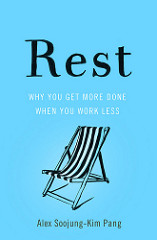
Add REST: WHY YOU GET MORE DONE WHEN YOU WORK LESS to your Goodreads shelf

My books on Goodreads
 The Distraction Addiction: Getting the Information You Need and the Communication You Want, Without Enraging Your Family, Annoying Your Colleagues, and Destroying Your Soul
reviews: 78
ratings: 316 (avg rating 3.53)
ratings: 316 (avg rating 3.53)


