-
A Little Respect: Involving Citizens in Technology Assessment | The Intersection | Discover Magazine"It became apparent after two years-worth of numerous discussions with a variety of stakeholders, that reopening the “old” OTA would leave little, if any, opportunities to invoke contemporary applications critical to 21st century governing: decentralized expertise (tapping the knowledge of scientists across the nation) and citizen engagement, to name but two."
-
"A new report from the Science and Technology Innovation Program at the Woodrow Wilson International Center for Scholars defines the criteria for a new technology assessment function in the United States. The report, Reinventing Technology Assessment: A 21st Century Model, emphasizes the need to incorporate citizen-participation methods to complement expert analysis. Government policymakers, businesses, non-governmental organizations, and citizens need such analysis to capably navigate the technology-intensive world in which we now live."
-
"[T]his year's pollen counts, especially in the southeast, are through the roof, and… a new study from the National Wildlife Federation (NWF) suggests allergies will likely become even more fierce if the planet continues to heat up. Researchers found that not only is spring coming earlier, making for a longer allergy season, but warmer weather allows hickory and oak, two of the most allergenic tree species, to thrive almost everywhere in the US. Another factor: Some plants, such as ragweed, are actually making more pollen as the environment changes. "As trees that use the wind to pollinate undergo stress from heat or lack of water, they begin to produce more pollen to compensate," explained NWF climate scientist Amanda Staudt. Scientists have already observed this phenomenon in cities, where C02 levels are an average of 30 percent higher than in suburbs and rural areas. "Cities are where we’re seeing increased pollen production," explains Demain.
-
"No matter what it looks like, a handmade map offers several advantages over a road atlas or the directions you get from Google…. The crucial advantage of the handmade map is that it is designed for a particular person confronting a particular task… A proper atlas must include every street name, not just the names of the streets you're looking for. By comparison, the minimal amount of information [on a hand-drawn map] makes for a map that's easier to use than one that's cluttered with detail…. Homemade maps also play with scale in fascinating ways:" by magnifying unfamiliar areas or tricky places, they can distort scale to increase comprehension…. Handmade maps also tend toward straight lines and right angles, a phenomenon spatial psychologists refer to as "rectilinear normalization."… Homemade maps often include error indicators, signs that you've taken a wrong turn or gone too far.
-
Better military technology does not lead to shorter wars - University of Gothenburg, SwedenIt is generally assumed that military technology that is offensive rather than defensive in nature leads to shorter wars. Yet, a new doctoral thesis from the University of Gothenburg shows that this assumption is not correct.
Alex Soojung-Kim Pang, Ph.D.
I study people, technology, and the worlds they make
Month: April 2010 (page 1 of 3)
Darlene Cavalier has a great piece in Discover about citizen science and reimagining the Office of Technology Assessment. As she explains,
What originally began as Science Cheerleader’s effort to help reopen the Congressional Office of Technology Assessment (an agency, shut down in the 90’s, that helped Congress better understand policy implications of complex, science issues), has evolved into this reincarnation.
Why? It became apparent after two years-worth of numerous discussions with a variety of stakeholders, that reopening the “old” OTA would leave little, if any, opportunities to invoke contemporary applications critical to 21st century governing: decentralized expertise (tapping the knowledge of scientists across the nation) and citizen engagement, to name but two….
Government policymakers, businesses, non-governmental organizations, and citizens rely on analysis to capably navigate the technology-intensive world in which we now live. The new model, described in the report, would provide opportunities to generate input from a diverse public audience, while promoting societal discussions and public education.
This redefines the technology assessment model by recommending the formation of a first-of-its-kind U.S. network to implement the recommendations: Expert and Citizen Assessment of Science and Technology (ECAST).
I'm very interested in systems like this, so I want to take a quick shot at outlining a couple properties that an ECAST would actually have to have to work.
First is a philosophical question. Does this kind of knowledge about the potential impacts of science and technology simply exist somewhere? Or does it need to be created?
Put another way, if you assume the former, your task is to find the person- the orthogonal thinker in a dorm room, the visionary at the startup- who can share a cool insight. If it's the second, then your task is to bring together interesting people, and get them to think together about the future of science and technology.
I've had some clients who were firm believers in the first approach. They wanted me to find the undiscovered visionary: one client more or less told me that my mission was to find the 16 year-old who could become another Steve Jobs, and to find him in China. Wrapped up in this mandate are a couple assumptions: that there's someone out there who sees the future really clearly, and we just need to find them; that such people are the ones who make history (and the future); and that we'll know this person when we find them.
I think each of these three assumptions is faulty. History isn't made by visionaries who spend a lifetime pursuing One Single Vision: I'm not sure that Steve Jobs had a vision for the iPhone that I could have extracted from him in 1973, when he was still- well, before he was Steve. Further, great technologies just aren't made by single people: like all creative endeavours, they're collaborative efforts. Finally, I'm not sure how you'd sort out crackpot from genius ideas about the future in any over-the-transom process.
But this is not say that a simple process that taps the raw "wisdom of the crowds"- say polling people, or opening up a wiki about the implications of science and technology- is a substitute. My experience trying to get experts to contribute to an open future of science platform makes me skeptical that you'll get useful results just by throwing open the doors, however nice they are. (One of the Discover commenters makes this point, too.)
Rather, you need a process that has several properties.
First, it needs to be accessible to just about anyone who wants to participate. There should be some kind of barriers to participation, to discourage people who want to just advocate for their products or talk about how putting microchips in our food will make us all super-geniuses.
Second, it should combine open-ended scanning with events that have clear dates. You need the former because innovation and other interesting things happen all the time; you need the latter because you need mechanisms to encourage concentration and innovative thinking (and hard deadlines and urgency are shown to stimulate more out-of-the-box thinking than leisure and freedom- a fact that many an academic has discovered the hard way).
Third, the system should thoughtfully draw on the wide varieties expertise that can be brought together in a virtual platform. Personally I think talking in terms of "citizens" and "experts" threatens to obscure something important, namely that "expertise" about exceptionally complex phenomena is highly distributed and localized. If you want an opinion about the value of Lie numbers in Garrett Lisi's theoretical physics, there are about a dozen people in the world you want to talk to (mainly this guy); if you want to think about the broad implications of synthetic biology, you want Rob Carlson, but you also want a lot of other people who can contribute expertise in law, engineering, manufacturing, policy, etc. etc. As the history of science shows, sometimes the people least likely to see the long-term implications of ideas or inventions are the scientists and engineers most intimately involved with their creation.
Fourth, you need some real-world events. Virtual meetings can be great- they generally suck, but they can be designed to be great (I make part of my living designing them)- but face-to-face interactions still produce things that you don't get through online itneractions. Even better are events that combine virtual and real interactions and spaces: if properly designed, you get the best of rich social interactions that, as primates, we're so good at, and the virtues of digital scribing and recording and sharing.
Finally, the exercise has to have an obvious payoff. This means two things. First, if it can be designed to provide some immediate benefits to participants- class credit for students, data for grad students, citations for professors, networking opportunities for entrepreneurs, a thousand new Facebook for the rest of us- so much the better. Second, it should be clear that people from NIH (or Merck or CIA or NSF) are actually paying attention to the results of Cubesat Day or Synthetic Biology Week. That raises the stakes, creates more of a sense of urgency, and makes everyone take the event more seriously.
Now, what kind of technology platform would you use?
My answer for now is, try a little of everything. Unless you get caught in the trap of sourcing the whole project to some soul-sucking systems contractor who'll charge your $37 billion and not really ever deliver what you want, you could do a lot of cheap experiments, in lots of cities; so long as you document well and pay close attention, pretty soon you'll see what works and what doesn't, and you can transplant successful efforts to other places. Don't think in terms of a system, in other words: think in terms of an ecosystem, in which you provide some minimal nutrition (seed funding), encourage rapid evolution, have lots of plasmids and transfer RNA around, and quickly reward success. Maybe that sounds like a cop-out, but it's the best way to get a system that's as flexible and interesting as its subject.
Or am I missing something?
-
Tweetage Wasteland : We All Have Photographic Memories"The digital age gives a new (and almost opposite) meaning to having a photographic memory. The experience of the moment has become the experience of the photo."
-
A "group of us volcano strandees in London planned and executed an event called TEDxVolcano last weekend. This is the story of how we did it, and five lessons about social capital mobilization that extend far beyond the ash plumes of Eyjafjallajokull." The lessons: #1. Cultivate Networks Way In Advance Of Using Them. #2. Identify Key Partners Early. #3. Ask For A Lot. #4. Talk Publicly (Because You Don't Know Everyone Who Can Help). #5. Say Thanks Constantly. BONUS: Distribute Praise Widely. [Though it's easier to pull this off in London than, well, just about anywhere else.]
-
Is there a formula—some mix of love, work, and psychological adaptation—for a good life? For 72 years, researchers at Harvard have been examining this question, following 268 men who entered college in the late 1930s through war, career, marriage and divorce, parenthood and grandparenthood, and old age. Here, for the first time, a journalist gains access to the archive of one of the most comprehensive longitudinal studies in history. Its contents, as much literature as science, offer profound insight into the human condition—and into the brilliant, complex mind of the study’s longtime director, George Vaillant.
-
Transcript: NIC Chairman Thomas Fingar Presents "Global Trends 2025" | Atlantic CouncilVery interesting talk about the 2025 global trends scenarios.
-
The anti-PowerPoint Generals - By Tom Ricks | The Best DefenseMattis also spoke without any computer graphics. "The reason I didn't use PowerPoint is, I am convinced PowerPoint makes us stupid." I don't know if I'd go that far, but its absence of verbs does seem to me to emphasize aspirations without saying what actions we intend to take to realize them. Army Brig. Gen. H.R. McMaster, who also spoke at the conference, also took a pop at PowerPoint, saying that when combined with certain ill-advised metrics, it "is really dangerous."
-
Essay: Dumb-dumb bullets - July 2009 - Armed Forces Journal - Military Strategy, Global Defense StrategyEvery year, the services spend millions of dollars teaching our people how to think. We invest in everything from war colleges to noncommissioned officer schools. Our senior schools in particular expose our leaders to broad issues and historical insights in an attempt to expose the complex and interactive nature of many of the decisions they will make. Unfortunately, as soon as they graduate, our people return to a world driven by a tool that is the antithesis of thinking: PowerPoint. Make no mistake, PowerPoint is not a neutral tool — it is actively hostile to thoughtful decision-making. It has fundamentally changed our culture by altering the expectations of who makes decisions, what decisions they make and how they make them. While this may seem to be a sweeping generalization, I think a brief examination of the impact of PowerPoint will support this statement.
-
Small Wars Journal: SWJ Blog: The TX Hammes PowerPoint Challenge (Essay Contest)PowerPoint has been the 21st Century’s solution to the age-old requirement for organizations to report information between various levels of bureaucracy—whether it be a sales pitch to board members, or an air crew mission briefing for a flight of Black Hawk helicopters. But PowerPoint is only as smart as those who are using it. In the military, business and even in NASA, misuse of PowerPoint can cause confusion and frustration. In the hands of a poor communicator, PowerPoint can spread misinformation, leading to bad decision-making. But we will also look at the flip side of the coin: despite the pervasiveness of elaborate PowerPoint presentations within the military, we will also look at PowerPoint presentations that would be considered poor by conventional standards, but actually communicated a message far more effectively than many other presentations.
-
Enemy Lurks in Briefings on Afghan War - PowerPoint - NYTimes.comGen. Stanley A. McChrystal, the leader of American and NATO forces in Afghanistan, was shown a PowerPoint slide in Kabul last summer that was meant to portray the complexity of American military strategy, but looked more like a bowl of spaghetti. “When we understand that slide, we’ll have won the war,” General McChrystal dryly remarked, one of his advisers recalled, as the room erupted in laughter. The slide has since bounced around the Internet as an example of a military tool that has spun out of control. Like an insurgency, PowerPoint has crept into the daily lives of military commanders and reached the level of near obsession.
-
Technological innovations are key causal agents of surprise and disruption. In the recent past, the United States military has encountered unexpected challenges in the battlefield due in part to the adversary's incorporation of technologies not traditionally associated with weaponry…. [T]he Committee for Forecasting Future Disruptive Technologies [was tasked] with providing guidance and insight on how to build a persistent forecasting system to predict, analyze, and reduce the impact of the most dramatically disruptive technologies. The first of two reports, this volume analyzes existing forecasting methods and processes. It then outlines the necessary characteristics of a comprehensive forecasting system that integrates data from diverse sources to identify potentially game-changing technological innovations and facilitates informed decision making by policymakers.
-
World Climate: A Computer-Simulation-Based Role-Playing Exercise — Climate InteractiveWorld Climate (formerly the Copenhagen Climate Exercise, or CCE) is a role-playing climate simulation designed by MIT and Sustainability Institute that gives groups from 10-60 an experience of reaching a global agreement to mitigate climate change.
-
R. Buckminster Fuller Digital Collection: World Game
-
Space Time Play: Computer Games, Architecture and Urbanism (pdf; sub req)
-
Raoul Bunschoten, "Scenario Games: Vital Techniques for Interactive City Planning" (PDF; sub req)"Scenario games are planning methods to test the viability of prototypes before they are developed by the participants. A scenario game should be the community of a prototype; to sustain this community and its interactions through the game and the life of a prototype is the key to the success of a coevolving plan, a dynamic master plan. Over the years, we developed game rules and started using the four basic processes we formulated after many attempts with role modeling and other characters failed: erasure, origination, transformation and migration as the drivers of the game. The four basic processes create the dynamic substance of the narrative while importing other key processes that form a reality through which a prototype can be tested. Participants are actors through these processes, but become authors once they insert prototypes."
To quote Bart Simpson. Looks like brain enhancement games is about as effective as… other technologies that claim to be able to enhance… less cerebral body parts. Not Exactly Rocket Science says:
You don’t have to look very far to find a multi-million pound industry supported by the scantiest of scientific evidence. Take “brain-training”, for example. This fledgling market purports to improve the brain’s abilities through the medium of number problems, Sudoku, anagrams and the like. The idea seems plausible and it has certainly made bestsellers out of games like Dr Kawashima’s Brain Training and Big Brain Academy. But a new study by Adrian Owen from Cambridge University casts doubt on the claims that these games can boost general mental abilities.
[To the tune of Suba, “Sereia,” from the album The Rough Guide To Brazilian Electronica (a 3-star song, imo).]
George Bush talking about starting the George W Bush Institute, via Wonkette:
One of the things I was nervous about about a think tank is that all we do is have people come here and they sit around and think…. I think it’s important not only to have people come around and think and have experts write and opine, but also to figure out how to act.
[To the tune of Philip Glass, “Koyaanisqatsi,” from the album Koyaanisqatsi (a 4-star song, imo).]
-
Publications list.
-
Ilya Farber, "The world within the skull," Nature (2001), rev. of Llinas "I of the Vortex" (sub req)"Llinás argues convincingly that the centralization of motor control produces the need for the organism to monitor and predict its own bodily state. The pervasive, intimate, moment-to-moment 'sense of self' that we all enjoy is thus to be understood not as the product of some evolutionary leap in cognitive or perceptual sophistication, but as a functional prerequisite for the deliberate control of action."
-
Jay Seitz, "The bodily basis of thought," New Ideas in Psychology (2000)"Classical cognitivist and connectionist models posit a Cartesian disembodiment of mind assuming that brain events can adequately explain thought and related notions such as intellect. Instead, we argue for the bodily basis of thought and its continuity beyond the sensorimotor stage. Indeed, there are no eternally fixed representations of the external world in the “motor system”, rather, it is under the guidance of both internal and external factors with important linkages to frontal, parietal, cerebellar, basal ganglionic, and cingulate gyrus areas that subserve cognitive and motivational activities. Indeed, the motor system, including related structures, is a self-organizing dynamical system contextualized among musculoskeletal, environmental (e.g., gravity), and social forces. We do not simply inhabit our bodies; we literally use them to think with."
-
Trends in Neurosciences : The moving origins of ‘self’ (sub req)"Llinás goes on to suggest that the ultimate function of the brain is prediction, and that the self is the centralization of prediction. This argument is advanced in a linear fashion, supported by a wealth of information on the physiology of motor control. One reason why this rationale is so persuasive is because the motor ‘card’ is precisely what has been missing from play in a number of theories of consciousness. The unsatisfactory nature of concepts of mind based on sensory perception, and the uneasy discomfort generated by such hypotheses, is laid bare by this, now patently evident, idea. Although the argument is complex, the basic idea is simple and almost obvious. Such simple ideas are the stuff of quantum leaps in science."
-
Review of Rudolfo Llinas, "I of the Vortex: From Neurons to Self," American Scientist, 2001"Active movement—what Llinás calls motricity—is the very source and main stem of mental life. "That which we call thinking is the evolutionary internalization of movement." Only organisms that move have brains, Llinás points out. A tree has no need of a central nervous system because it's not going anywhere, but an animal on the prowl needs to see where it's headed and needs to predict—perhaps even envision—its future place in the world. The poster—child organism for this close connection between motricity and mentality is the sea squirt. This marine creature starts life as a motile larva, equipped with a rudimentary brainlike ganglion of about 300 neurons. But after a day or two of cavorting in the shallows, the larva finds a hospitable site on the bottom and puts down roots. As a sessile organism, it has no further use for a brain, and so it eats it!"
-
Philosophical Transactions of the Royal Society, Series B (May 12, 2009, 364 (1521))"Just as physicists can explain complex systems with a small set of elegant equations (e.g. Maxwell's), it might be possible for the multidisciplinary study of the brain to produce a list of well-defined universal principles that can explain the majority of its operation. Given exciting developments in theory, empirical findings and computational studies, it seems that the generation of predictions might be one strong candidate for such a universal principle. Predictions in the brain is the focus of the collection of papers in this special theme issue."
I have many other things to work on at the moment, but I want to call attention to this amazing, and I think incredibly important, special issue of the Philosophical Transactions of the Royal Society on "Predictions in the Brain:"
Just as physicists can explain complex systems with a small set of elegant equations (e.g. Maxwell's), it might be possible for the multidisciplinary study of the brain to produce a list of well-defined universal principles that can explain the majority of its operation. Given exciting developments in theory, empirical findings and computational studies, it seems that the generation of predictions might be one strong candidate for such a universal principle. Predictions in the brain is the focus of the collection of papers in this special theme issue…. [T]hese papers range from addressing cellular underpinnings to computational principles to cognition, emotion and happiness, and they cover predictions that range from the next turn for a rat navigating a maze to predictions required in social interactions.
It includes articles by a bunch of great people, including Thomas Suddendorf, whose work on cognitive evolution and the capacity to think about the future I find extremely stimulating; Rodolfo Llinás, author of the great book I of the Vortex; and Daniel Gilbert, whose terrific book Stumbling on Happiness introduced me to the neuroscientific literature on future thinking.
I'm not sure how much of it is publicly available- I got to the collection through two different library systems, and have no idea what was automatically authorized.
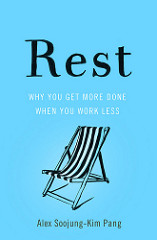
Add REST: WHY YOU GET MORE DONE WHEN YOU WORK LESS to your Goodreads shelf

My books on Goodreads
 The Distraction Addiction: Getting the Information You Need and the Communication You Want, Without Enraging Your Family, Annoying Your Colleagues, and Destroying Your Soul
reviews: 78
ratings: 316 (avg rating 3.53)
ratings: 316 (avg rating 3.53)


