-
"The markets want money for cocaine and prostitutes. I am deadly serious. Most people don’t realize that “the markets” are in reality 22-27 year old business school graduates, furiously concocting chaotic trading strategies on excel sheets and reporting to bosses perhaps 5 years senior to them. In addition, they generally possess the mentality and probably intelligence of junior cycle secondary school students. Without knowladge of these basic facts, nothing about the markets makes any sense—and with knowladge, everything does. What the markets, bond and speculators, etc, want right now is for Ireland to give them a feel good feeling, nothing more. A single sharp, sweeping budget would do that; a four year budget plan will not."
Alex Soojung-Kim Pang, Ph.D.
I study people, technology, and the worlds they make
Month: October 2010 (page 1 of 5)
-
"[T]he Tetlock Gambit is a kind of pundit's hedge: it's an outrageous prediction, made in the hope of a big payoff if it comes true, and with the knowledge that there'll be no penalty if it's false. So you can't be a true believer in, say, the idea that we'll use nanotechnology to rewire our brains, and forecast the same; you must make such a prediction self-consciously and cynically." As Justin Wolfers explains his midterm election prediction: "If I’m right? Well you can bet that I’ll beat the drums loudly and tell everyone in sight that I called it. I’ll blog it all week. I’ll write an op-ed explaining my insights. I’ll go on to Jon Stewart’s show to explain the fine art of psephology. Hopefully you’ll be calling me the Nouriel Roubini of political punditry. I’ll go on to a new life of lucrative speaking engagements and big book advances, while I beat back my coterie of devoted followers. And if I’m wrong? We both know there won’t be any real consequences."
A few years ago, I coined the term Nunberg Error, in honor of Geoffrey Nunberg and his observation about our tendency when forecasting to overestimate the impact of technological change while underestimating social change. It's time now to coin a new term, just in time for the avalanche of punditry around the midterms: the Tetlock Gambit.
Briefly, the Tetlock Gambit (named in honor of Philip Tetlock, author of the fantastic book Expert Political Judgment) is a kind of pundit's hedge: it's an outrageous prediction, made in the hope of a big payoff if it comes true, and with the knowledge that there'll be no penalty if it's false. So you can't be a true believer in, say, the idea that we'll use nanotechnology to rewire our brains, and forecast the same; you must make such a prediction self-consciously and cynically.
The example that inspires all this? Penn professor Justin Wolfers:
The Democrats will retain control of the House and the Senate. And I’m the only person in D.C. insightful enough to make this brave forecast.
If I’m right? Well you can bet that I’ll beat the drums loudly and tell everyone in sight that I called it. I’ll blog it all week. I’ll write an op-ed explaining my insights. I’ll go on to Jon Stewart’s show to explain the fine art of psephology. Hopefully you’ll be calling me the Nouriel Roubini of political punditry. I’ll go on to a new life of lucrative speaking engagements and big book advances, while I beat back my coterie of devoted followers.
And if I’m wrong? We both know there won’t be any real consequences. I’ll be sure to sell some clever story. You know, there was weather on election day (hot or cold, wet or dry — it all works!) and this messed with turnout. Or perhaps, This Time Was Different, and my excellent forecast was knocked off course by our first black president, by rising cellphone penetration or a candidate who may not be a witch. I’ll remind you how I nailed previous elections. (Follow the links, you’ll see I’m doing it already!) I’ll bluster and use long words like sociotropic, or perhaps heteroskedastic. And I’ll remind you that my first name is Professor, and I went to a prestigious school. More to the point, if I’m wrong, I’m sure we’ll all have forgotten by the time the 2012 election rolls around. Shhhh… I won’t tell if you won’t.
As he confesses at the end of his prediction,
[Y]es, my forecast is more about the marketplace for punditry than it is about this election. I’m influenced strongly by my Penn colleague Philip Tetlock, who has spent decades pointing out just how bad expert political judgment is. Given these market failures, I would be a fool not to go for the gold.
It was inevitable that someone would read Tetlock as a manual for how to succeed as a pundit, rather than as a caution against trusting pundits, much as Michael Lewis' Liar's Poker was read by some college students as a how-to manual for success on Wall Street, not a caution against going into finance.
No wait, someone has already done it: I did, in my "Evil Futurists' Guide to World Domination."
Okay, here’s one for all my smart friends.
In my scenarios project, I’m taking an approach in which I treat scenarios not as texts to be read from start to finish, but as a combination- a package or portmanteau- of formal content, tacit knowledge, media of various types (reports, maps, rigorous analytical stuff, more imaginative stories, etc.), and even events or performances (e.g., workshops, client engagements). One of the things I’m interested in is following how scenarios get used in different contexts, and how the constituent parts of scenarios are sometimes carved off from the whole, repurposed and reused.
I think there’s a parallel here to architectural movements and their impacts. Something like neoclassicism or the International Style isn’t a single concept; it’s a whole package of ideas and forms, and while it can be influential worldwide, it’s not influential in the same way everywhere. Sometimes different elements are pulled out and emphasized in different parts of the world: think of how modern architecture in Brazil and Japan have played out, with the former being much more sculptural and sensual. Local materials may blunt the strangeness of a foreign style. Or guiding principles inspire very different kinds of works: Art Nouveau in Vienna and Aberdeen are pretty different creatures.
This is stock in trade in the history of architecture, but I’m a lot more familiar with specific periods in architectural history, or the works of particular architects, than I am with the historiography; so while I can point to lots of examples of this kind of localization and reinterpretation, I don’t know of anyone who’s written about the process in more general terms. Do such articles exist?
[To the tune of Joshua Rifkin: The Bach Ensemble, “Kyrie: Kyrie Eleison #2,” from the album Mass in B Minor (BWV 232) (a 4-star song, imo).]
-
Fred Charles Ikle, "Social forecasting and the problem of changing values: With special reference to Soviet and East European writings"The usefulness of statements about the future… must be judged according to the purpose that they serve. In order to be useful for planning, forecasts must be linked, or permit being linked, to policy options. That is to say, only if statements about the future can be placed into a context that describes the consequences of alternative courses of action open to us, can they help us to shape the future more to our liking. Frequently, statements about the future are being made that cannot be related to alternative courses of action, and hence cannot be used to guide planning. Such predictions might serve purposes of entertainment, or perhaps provide some desired spiritual edification.
-
CorporatePR: In Defense of Noise"I acknowledge the sheer and increasing difficulty of following that first rule of social media (endlessly recounted in books, presentations, blogs and so forth): LISTEN (damn it). (Or else.) And yet, I can't help but think that through our quest to reduce the noise, we are, in fact, getting rid of that which is most important to the formation of a sense of community. I have a hunch that it is exactly from the noise that community arises. That the emotional connections we are making with members of our networks (friends, followers, etc.) come from the noise, not the facts, the links shared, etc. I fear that through cutting down the noise, we are handicapping communications."
Today, as part of my wife’s birthday and in preparation for our sabbatical in Cambridge, we bought a new camera, a Nikon D5000. I’ve had compact digital cameras for years- I keep one in my pocket pretty much all the time- so this is a big change in terms of technical quality and sophistication.
Naturally I played around with it this afternoon, and took a few pictures in the backyard.

backyard, via flickr
Since we also had a birthday dinner tonight, the camera went there, too.
birthday cake, via flickr
While the D9000 is supposed to be a step down from the more professional D90, it’s been years since I had a “serious” camera- e.g., one heavy enough to hurt if you hit someone over the head with it, and sturdy enough to take a picture of them on the ground afterwards.

my brother in law and me, via flickr
Between the ability to shoot some very fast pictures (the autofocus and latency are awesome), and the ability to turn off all the controls, put an old Nikon lens on the camera, and really see what happens when you play around with exposure, f-stop, and aperture, I think it’s going to be a long time before I feel like I exhaust all the possibilities of the camera.
The one thing I know I have to resist is falling into Camera Guy World- you know, the land where people obsess over different models of lenses, filters, etc. I just don’t want to get sucked into that world, because I know I’d waste a lot of time and energy there. I just want to take good pictures, and not spend 50% of my time chasing after that last 2% of value. Better to spend time out in the field, or taking pictures of the kids.
Though they may not feel that way!
my daughter voting for no more cameras, via flickr
[To the tune of Kronos Quartet, “Trad: Brudmarsch Fra Osta,” from the album Early Music (Lachrymæ Antiquæ) (a 2-star song, imo).]
-
The Power of Time OffA couple of weeks ago, I headed down to Montezuma, Costa Rica to spend a week at Anamaya Resort for my “think week”, which consisted of a lot of yoga, meditation, reading, and eating. If you haven’t taken a week off to reflect on your past and your future, it’s something I highly recommend. Steve Jobs, Mark Zuckerburg, and Bill Gates have done it. You should too.
-
The Dark Side of Creativity: Biological Vulnerability and Negative Emotions Lead to Greater Artistic Creativity — Pers Soc Psychol BullHistorical and empirical data have linked artistic creativity to depression and other affective disorders. This study examined how vulnerability to experiencing negative affect, measured with biological products, and intense negative emotions influenced artistic creativity. The authors assessed participants' baseline levels of an adrenal steroid (dehydroepiandrosterone-sulfate, or DHEAS), previously linked to depression, as a measure of affective vulnerability. They then manipulated emotional responses by randomly assigning participants to receive social rejection or social approval or to a nonsocial situation. Participants then completed artistic collages, which were later evaluated by artists. Results confirmed a person-by-situation interaction. Social rejection was associated with greater artistic creativity; however, the interaction between affective vulnerability (lower baseline DHEAS) and condition was significant.
-
Feeling Sad Makes Us More Creative | Wired Science | Wired.comResearch on the relationship between mood, creativity and memory teach us two things. "The first is that our fleeting feelings can change the way we think. While sadness makes us more focused and diligent — the spotlight of attention is sharpened — happiness seems to have the opposite effect, so that good moods make us 20 percent more likely to have a moment of insight. The second takeaway is that many of our creative challenges involve tasks that require diligence, persistence and focus. It’s not easy making a collage or writing a poem or solving a hard technical problem, which is why sometimes being a little miserable can improve our creative performance."
-
Modupe AkinolaProfessor Akinola examines how organizational environments- characterized by deadlines, multi-tasking, and other attributes such as having low status- can engender stress, and how this stress can have spill-over effects on performance. She uses a multi-method approach that includes behavioral observation, implicit and reaction time measures, and physiological responses (specifically hormonal and cardiovascular responses) to examine how cognitive outcomes are affected by stress.
Interesting concept: make a video pieced together from YouTube videos in which the camera is dropped.
oops from Chris Beckman on Vimeo.
As Petapixel comments, “What’s amazing is how seamlessly the clips are stitched together, making it difficult to discern where one clip ends and the next begins.” The end result is a video that feels like it’s of one camera being dropped in one part of the world, and picked up in another. Very neat.
[To the tune of Kronos Quartet, “Getme, Getme (Dont’t Leave, Don’t Leave),” from the album Floodplain (a 4-star song, imo).]
-
Modupe AkinolaProfessor Akinola examines how organizational environments- characterized by deadlines, multi-tasking, and other attributes such as having low status- can engender stress, and how this stress can have spill-over effects on performance. She uses a multi-method approach that includes behavioral observation, implicit and reaction time measures, and physiological responses (specifically hormonal and cardiovascular responses) to examine how cognitive outcomes are affected by stress.
Add REST: WHY YOU GET MORE DONE WHEN YOU WORK LESS to your Goodreads shelf
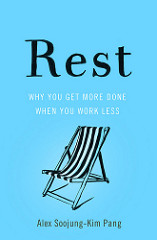

My books on Goodreads
 The Distraction Addiction: Getting the Information You Need and the Communication You Want, Without Enraging Your Family, Annoying Your Colleagues, and Destroying Your Soul
reviews: 78
ratings: 316 (avg rating 3.53)
ratings: 316 (avg rating 3.53)


