Alex Soojung-Kim Pang, Ph.D.

I study people, technology, and the worlds they make

Month: January 2011 (page 1 of 3)

Saturday in Ely

Today we went to Ely, which is about 15 minutes from Cambridge by train. It’s a much smaller town, but has one of the most impressive cathedrals in Britain. (Heather’s account of the visit is already up, and she has several pictures.) Since we went to evensong at King’s College chapel- which is one of the most remarkable examples of English Perpendicular architecture- it was interesting to compare them.

We biked from our house to the train station, finally found a space in the bike parking area (which is nuts), and after many minutes in line, bought tickets. This was the first time I was using the electronic ticket kiosk and my local chip-and-pin card, and with a large line behind me, I just wanted to get through the transaction as quickly as possible; as a result, I bought two one-way tickets, but at least they were to the right place.

Ely Cathedral
via flickr

The train ride is short but pleasant, and there’s a walk from the train station to the cathedral that is generally unobjectionable but not amazing. However, there was a horse along the way.


via flickr

We stopped for a Cornish pasty before going in the cathedral, then spent the next several hours immersed in late medieval ecclesiastical architecture. The high point, literally and figuratively, was the tour of the Octagon and Lantern, an unusual feature of the cathedral added in the 1300s. The tour first takes you up onto the roof, which is pretty cool.


via flickr

The tour involves a lot of narrow staircases.

Ely Cathedral
via flickr

You can view the stained glass up close. A lot of it is actually Victorian rather than medieval- between the Reformation, Civil War, and 500 years’ time, much of the original was lost by the time the Victorians rediscovered the art and restored the stained glass.


via flickr

Getting close to it is really great.

Ely Cathedral
via flickr

Next you ascend to the level with the painted panels. While it looks like it’s made of stone and metal, most of the Octagon is actually wood, covered in lead.

Ely Cathedral
via flickr

They open up the panels on the octagon, so you could look across….

Heather in the Octagon
via flickr

…and down.


via flickr

Finally, we went up onto the roof. During clear weather, it afford a terrific view of the Fens, but it was pretty cloudy today; still, it was impressive, and very cold.

Ely Cathedral
via flickr

Ely Cathedral
via flickr

After that we walked around town a bit, and inevitably arrived at the best bookstore in Ely, and possibly the world: Topping & Co.


via flickr

It’s an unexpected find- a wonderful three-story, crowded bookstore, with an excellent staff who know what they’re doing.


via flickr

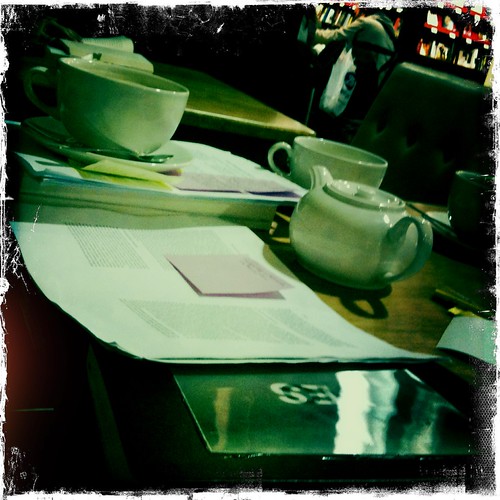
Not only did they have a couple books I wanted, they offer their patrons pots of tea or coffee, which is not only very welcome on cold days, but it also increases the odds that people will buy stuff.


via flickr

It worked on me, but they’re books for work, so it was all right.

Today’s adventure is London, and the British Museum and Bloomsbury.
Biking around Cambridge

I’ve done a lot of bicycling here. I do a certain amount of biking in California, but this is one of the most bike-friendly places I’ve ever lived. (Not having a car also makes a difference.)


via flickr

The bikes are ubiquitous, and they go everywhere, it seems.


via flickr

Part of the improvisational quality of biking comes from the fact that it’s not always clear here what’s a single-lane road, and what isn’t. Some of the roads are very old, and expanding them isn’t really an option.


via flickr

It all reminds me of sociologist Harry Collins’ explanation of the different kinds of knowledge: riding a bicycle involves embodied and tacit knowledge, while successfully riding a bicycle in traffic is a form of local knowledge. The former involves learning how to operate a piece of machinery; the latter requires learning how others behave, and how they’ll treat you if you act in certain ways.

Nicholas Carr, The Shallows

Spent the day (and most of the evening) reading Nicholas Carr’s new book, The Shallows. The money graf:

“[I]f, knowing what we know today about the brain’s plasticity, you were to set out to invent a medium that would rewire our mental circuits as quickly and thoroughly as possible, you would probably end up designing something that looks and works a lot like the Internet. It’s not just that we tend to use the Net regularly, even obsessively. It’s that the Net delivers precisely the kind of sensory and cognitive stimuli- repetitive, intensive, interactive, addictive- that have been shown to result in strong and rapid alterations in brain circuits and functions.” It’s “the single most powerful mind-altering technology… since the book.” (116)

I’ll have a more detailed analysis of the book on the Contemplative Computing blog tomorrow. I’m trying to make my way through as much of what you might think of as the digital Cassandra literature as I can stand.

Predictive policing

From Slate:

Police departments have long been in the data game, with such efforts as CompStat. But there's a new twist: They're not just using statistics to assess the past. Now they're trying to predict the future. In November 2009, the National Institute of Justice held a symposium on "predictive policing," to figure out the best ways to use statistical data to predict micro-trends in crime. The Los Angeles Police Department then won a $3 million grant from the Justice Department to finance a trial run in predictive methodology. (The grant, like the rest of the 2011 federal budget, is pending congressional approval.) Other police departments are giving predictive policing a shot, too, from Santa Cruz, which recruited a Santa Clara University professor to help rejigger their patrol patterns, to Chicago, which has created a new "criminal forecasting unit" to predict crime before it happens….

Predictive policing is based on the idea that some crime is random—but a lot isn't. For example, home burglaries are relatively predictable. When a house gets robbed, the likelihood of that house or houses near it getting robbed again spikes in the following days. Most people expect the exact opposite, figuring that if lightning strike once, it won't strike again. "This type of lightning does strike more than once," says [UCLA anthropology professor Jeffrey] Brantingham. Other crimes, like murder or rape, are harder to predict. They're more rare, for one thing, and the crime scene isn't always stationary, like a house. But they do tend to follow the same general pattern. If one gang member shoots another, for example, the likelihood of reprisal goes up….

Data-driven law enforcement shows that the criminal mind is not the dark, complex, and ultimately unknowable thing of Hollywood films. Instead, it's depressingly typical—driven by supply, demand, cost, and opportunity. "We have this perception that criminals are a breed apart, psychologically and behaviorally," says Brantingham. "That's not the case."

On pipes

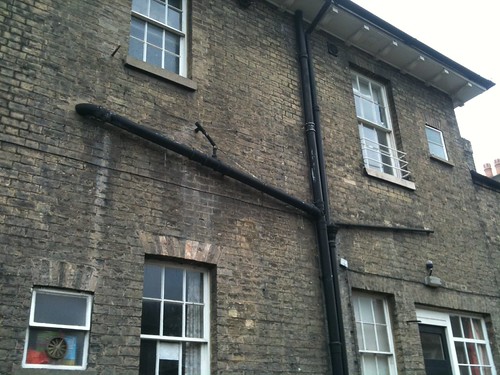
For me, one of the most memorable parts of Terry Gilliam’s dystopian classic Brazil was the pipes. If you haven’t seen the film, go watch it; if you have, you’ll remember the way that pipes are everywhere in the built environment. I always thought that was vivid and strange; now, though, I realize that it was one of those pieces of dystopian culture that is an absurd magnification of real life.

There are exposed pipes everywhere. In this bathroom, you can see them serving the hot water heater (which looks like it was added as a total afterthought):


via flickr

In this pub, the exposed pipes run around the toilet (you can also see the old timber, not quite covered up by they tile).


via flickr

And this house has running water, but it runs out of pipes on the exterior of the house.


via flickr

Sunday at the American Cemetery, Madingley

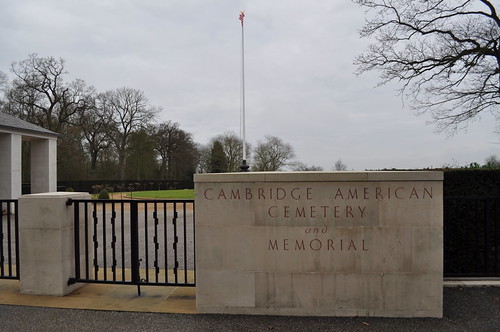
This morning, after getting Heather’s bike fixed up so it was a little more rideable, we took a short trip to the American Cemetery in Madingley, a cemetery devoted largely to airmen from the Eighth Air Force and sailors who served in the Battle of the Atlantic. I’d read a little about the cemetery, and one of my grandparents had served in the Eighth Air Force, and it seemed like an appropriate destination for a Sunday.


bicycling, via flickr

Following a path from Cambridge to the cemetery described by a local cycling blogger, we cycled through town, past the science center, and to the village of Coton. (There was an excellent thatched house there.)


thatched cottage, via flickr

From there we turned north, and about a mile later were at the cemetery.

American Cemetery at Madingley
entrance to the cemetery, via flickr

It’s quite a remarkable place. The 3,800 graves are laid out in a series of arcs, and to one side is a reflecting pool and a memorial wall with another 5,000 names of servicemen whose remains were never recovered (two dozen were later found). One of the names is bandleader Glenn Miller.


american cemetery, via flickr

There’s a chapel that’s an interesting mix of religious and grand strategy: one wall has a vast map of the European air war, with Cambridge at the center of American bombing operations, and the ceiling has a huge mosaic. It speaks of a level of absolute certainty that seems admirable- and increasingly, an artifact of an earlier age. (Many more pictures of the cemetery are on Flickr.)


air war map, via flickr

It’s a beautiful, sombre place. Well worth visiting.


chapel mosaic, via flickr

After that we bicycled back to Cambridge, went to Waterstones Books, and spent the next couple hours reading.

Reading about the future of HCI
reading at waterstones, via flickr

This being Sunday, we then came home for dinner. The whole town seems to kind of shut down after 5 on Sundary, and besides, we had plenty to do at home.

Being grownups

Today we spent a little time getting Heather settled in- a friend brought over a bike that she can use while she’s here, and we got her signed up at the local gym- then despite my knowledge of Saturday insanity in town, we bought some lights for the bike and did a little food shopping.

As a result, I cooked my first real meal since I got here: a kind of Asian fusion stir fry tikka masala, with rice. (We had had dinner at an Indian restaurant the night before, so I was kind of thinking about Indian food.)


dinner ingredients, via flickr

We have a small kitchen, but it’s certainly functional, and I’m figuring out where things go, and can go.


the kitchen, via flickr

After we finished, and spent some time talking to our son on Face Time (most of that was spent talking him through how he could add audio attachments to his iTunes library) we went out. Going out for a walk after dinner is the kind of thing adults do, or so we’ve heard.

We walked around our neighborhood for a while, then made our way along Victoria Road into town. We stopped at Clowns of Cambridge- where I went my first night here, but Heather had never been- for coffee.

Stop at Clowns of Cambridge
clowns of cambridge, via flickr

After that, then headed through town, made out way down to Mill Lane and the river, then along Queen’s College and back home.


mill lane, via flickr

We’ve figured out the heating system, and it turned out that the heat was on for about three hours a day, just enough to keep the pipes from freezing or something. Now it’s more habitable.

I spent the rest of the evening settled into the literature emotion and HCI, and how different approaches think of emotion in scientific/computational terms (i.e. as something that can be read through signals like pupil size, flushed cheeks, and other involuntary reactions or microsignals), and one that argues that emotions are, essentially, socially constructed. Interesting stuff, though as much for the disagreements it inspires as anything.

Back to Heathrow 2

Thursday Heather flew into Heathrow, so I took the bus from Cambridge to the airport, and picked her up.


Christ’s Pieces, via flickr

Most of the buses in Cambridge leave from the central station on Christ’s Pieces, but the airport buses originate and terminate a couple blocks to the south, at Parker’s Pieces. Fortunately, everything’s reasonably well marked, and it’s not too difficult to find the bus you need. (The Cambridge-to-Heathrow bus seems to be the 797, which also helps.)


parker’s pieces, via flickr

Heather’s plane was late leaving SFO, so it was delayed by a couple hours. I had to change our bus tickets, which meant a ridiculous set of fees (National Express, like most bank, seems to love them their transaction fees). After that, I headed from the Central Bus Station to Terminal 1. It’s a couple minutes away by tunnel, and then you’re in Terminal 1.


tunnel to terminal 1, via flickr

After looking around a bit, I found the restaurants at the departure level, in an upstairs area that overlooks check-in and security. So I spent the next couple hours there, doing some reading. There are a couple coffee places, so it was a pleasant enough place to spend time.


reading, via flickr

Eventually, Heather’s plane arrived, and we headed back to the bus station. There’s huge amounts of construction on the highways around London, and we were fighting both rush hour traffic and a couple accidents, so we ended up getting into Cambridge about an hour later than planned. C’est la vie.

What matters is that we made it, and have the next couple months in England, largely child-free. I don’t think I’m going to cease to find that amazing until after we’ve left.

Back to Heathrow

I’m off to Heathrow this morning. Decided I didn’t like England after all.

No, my wife is arriving today. Her flight’s a couple hours late, though, so I’ll be spending more of the day there than originally planned. Fortunately I’ve got stuff to keep me busy.

Amazing: stealing SIM cards from smart traffic lights

This is going on in Johannesburg:

Hundreds of [traffic] lights have been damaged by thieves targeting the machines' sim cards, which are then used to make mobile phone calls worth millions of South African rand.

More than two-thirds of 600 hi-tech lights have been affected over the past two months, according to the Johannesburg Roads Agency, causing traffic jams, accidents and frustration for motorists.

The traffic lights use sim cards, modem and use GPRS to send and receive information, a system intended to save time and manpower by alerting the road agency's head office when any lights malfunction. According to Thulani Makhubela, a spokesman for the agency, the robberies have been "systematic and co-ordinated", possibly by a syndicate. An internal investigation has now been launched.

"They know which signals to target," Makhubela added. "They clearly have information."

Wow. Real world, meet ubicomp!

Older posts

© 2017 Alex Soojung-Kim Pang, Ph.D.

Theme by Anders NorenUp ↑