No longer will readers be able to chuck a third free book onto their pile of purchases as they head to the till at Waterstone's: the UK's biggest bookseller is bringing its long-running three-for-two offer to an end.
The Bookseller reports that staff were told of the move yesterday, with the current three-for-two promotion across all paperback fiction to come to an end today. The demise of the famous offer, which has been running for more than a decade, follows the sale of the chain by HMV to Russian billionaire Alexander Mamut, and the appointment of independent bookseller James Daunt as managing director in June.
Alex Soojung-Kim Pang, Ph.D.
I study people, technology, and the worlds they make
Month: August 2011 (page 1 of 2)
How easy am I to please? Yesterday I took one of my old Airport Express stations- an older wifi station that, ever since I moved up to Airport Extreme, I've treated with contempt- and reconfigured it so I could stream music from my iPad or computer to my stereo.
It's not like I couldn't plug either of those devices into the stereo before, but the point is, now I don't have to: I have the richer sound of my stereo, the vastness of my music collection, and the ease of it being wireless. It's surprisingly liberating; but then again, if you think back to what it was first like to have wifi, maybe it shouldn't feel surprising at all.
Today, I took the other Airport Express, and hooked it up to some Cambridge Soundworks powered speakers, and set them on the other side of the garage. Serious DIY surround sound. (Subwoofers are things of beauty.)
It's a good reminder that unless they're actually BROKEN, old technologies probably can still have a use. Their problem may not be that they're obsolete, but that you're not imaginative enough to figure out what to do with them.
Update: Check out these two chatbots having a conversation.
Second update: Incredibly, I blogged about this on the pre-anniversary of the day Skynet will become self-aware
From an essay well-known in technical circles:
Exploring the horizons of technology requires courage because research carries risks, even if we cannot always articulate them in advance…. [T]he very nature of research poses its own special risk. In research, we daily face the uncertainty of whether our chosen approach will succeed or fail. We steep ourselves in elusive, mysterious, and unnamed phenomena, and we struggle to unravel very complex puzzles, often making no visible progress for weeks or months, sometimes for years. We strive for simplicity and clarity in a cloudy and often baffling world. The special risk of research starts with the high probability that any particular attempt will fail and follows from the resulting experience of repeated failure. Research carries a special risk of discouragement.
Sutherland also as a nice bit about structured procrastination and how he deals with it:
For me, the urgent often takes the form of a crowded desk that must be cleared. All those letters to write, a timesheet to bring up to date, bills to pay, checkbook to balance, personal computer disk to back up, and a host of other easy little routine tasks are available to help me avoid the difficult big task at hand….
I escape from the local pressures by going far away in an airplane, or not so far to a quiet library, or even closer to the seclusion of my study, particularly early in the morning. The important thing about all these retreats for me is that I can cast aside the urgent problems; the phone won’t ring, the checkbook can’t be balanced, and I can focus on my larger tasks with a fresh mind.
I found this article about bike commuting a few days ago, and found it both quite interesting, and very entertainingly written.
I acquired a secondhand steel frame bike for £50, spruced it up, and set off. I soon got into the swing of cycling the 27 miles (43.5 kilometres) from home in Sheffield, United Kingdom, to work in Chesterfield and back, managing it most days when I wasn’t on call and didn’t have commitments off site. After about six months of commuting I began to wonder whether the one way journey time of about 55 minutes could be reduced. Those in the know suggested a new bike could knock 10% off it.
Evidence based cycling is not high on the bicycle salesman’s agenda. No one will tell you how much more efficient one bicycle is over another; they just say it is better. Making a decision on what was perceived to be best and dreaming of extra time in bed, I looked into the UK government’s Cycle to Work scheme. This scheme allows an employee to purchase a bicycle (up to a cost of £1000 (€1180; $1560)) at a significant discount by using tax incentives, provided the bicycle is used for commuting to and from work. The initiative aims to “promote healthier journeys to work and reduce environmental pollution.”1 However, doubt has been expressed in the popular press regarding whether the new generation of middle aged men in lycra (MAMILs) are actually using their scheme funded bikes to commute or just to gum up the roads (particularly hills) at weekends. The benefits are debatable but attractive, and the scheme has encouraged a lot of people to spend a lot of money on high end bicycles. I purchased a bike at the top end of the cost allowed by the scheme and opted for a carbon frame because it was significantly lighter than my existing bicycle’s steel frame. The wheels were lighter and tyres narrower too. All were factors that made me believe that the extra £950 I had spent would get me to work in a trice.
My new bike seemed wonderful, if somewhat uncomfortable. I didn’t notice a dramatic decrease in commuting time, nor did the cycle computer I had fitted to my new bicycle to record any notably swift journeys. But, one sunny morning, I got to work in 43 minutes, the fastest I could recall. My steel bike was consigned to a corner of the garage to gather dust—until I had a puncture. The next day I was back on my old steel bike. I fitted the cycle computer, set off . . . and discovered I had got to work in 44 minutes. “Hang on,” I thought, “was that minute worth £950 or was it a fluke?” There was only one answer: a randomised trial. I toyed with the idea of blinding it but, in the interest of self preservation and other road users, decided against it.
I now bicycle just about everywhere, and only use the car when I'm carrying lots of groceries or kids; in fact, I'm trying an experiment this fall where I'll be letting a friend use the car for a couple months, and we'll see how well we can do with one vehicle. Mainly I bike for my health, and also to lower my carbon and pollution footprint (which I then more an make up for by grilling, I have no doubt); and I've often wondered if a "faster" bike really would be worth it in my more bike-oriented mode. The answer seems to be, probably not.
From Mortimer Adler’s How to Read a Book:
We must act. That is the final word in every phase of human life. I have not hesitated to praise the reading and discussion of great books as things intrinsically good, but I repeat: they are not the ultimate ends of life. We want happiness and a good society. In this larger view, reading is only a means to an end.
Government Computer News has a brief article about the ACE program. It focuses mainly on Applied Research Associates' Forecasting Ace, but it still gives a good overview of what the program is trying to achieve.
One of the interesting things I've witnessed in the last couple years is the effort of futurists and other professional forecasters- particularly financial forecasters- to incorporate behavioral economics and the findings of Expert Political Judgment into their work. The "predictably irrational" quality of decision-making, and the fundamental problem that our normal, popular assumptions the relationship between expertise and utility break down when dealing with the future, have been hard to work through. Many futurists still ignore the work, or argue that they don't really predict, and the rationality or irrationality of decision-making doesn't affect their work.
A recent piece by investment advisor Mitch Tuchman stands as a good example of how financial professionals are struggling with the work: "in most pursuits where dynamic and multiple variables determine what will happen," he notes, "experts are not good at predicting the future. And to make matters worse, those who predict are rarely held accountable for their prognostications." He concludes with a defense of index investing as the only really viable form of trustworthy financial prediction (one can reasonably think of investments as predictions), and that attempts to forecast more precisely are "expensive and distracting noise."
Tuchman also points to an article by Christina Fang and Jerker Denrell, which argued that people do successfully forecast an extreme economic event tend to do more poorly as general forecasters than the average. As their abstract explains,
Successfully predicting that something will become a big hit seems impressive. Managers and entrepreneurs who have made successful predictions and have invested money on this basis are promoted, become rich, and may end up on the cover of business magazines. In this paper, we show that an accurate prediction about such an extreme event, e.g., a big hit, may in fact be an indication of poor rather than good forecasting ability.
As the Financial Times gloomily summarizes,
economists who tend to predict near the consensus are, by definition, unlikely to anticipate extreme events, while those who correctly predict the occasional Black Swan tend to get everything else wrong (or most everything else).
Unfortunately, when it comes to economic forecasting, there’s really nowhere to turn, as the consensus view tends to miss even cyclical, non-Black Swan recessions.
The open question is whether an industry in which forecasting can be immensely important can develop incentives to improve forecasting practice. Financial advisors' decisions are pretty well-documented, and there are clear incentives for having advisor statistics be as accessible as baseball players'. Of course there are also clear disincentives as well. But forecasting is a site in which questions of expertise, transparency, and fairness converge: and so arguably it's as important to have good expert advice, and to know the value of that expertise, as it is to have good standards agencies or regulators who are immune to cognitive regulatory capture.
Johns Hopkins neuroscientist David Linden explains "the brain science behind gambling with the debt ceiling" on Reuters' Great Debate blog. It draws on, among other things, Barbara Mellers' work investigating how circumstances affect how people assess financial gains and losses.
The debt ceiling debate is raging in Washington. But what’s going on in the minds of the politicians working on the seemingly intractable problem? Barack Obama, Mitch McConnell, John Boehner and Eric Cantor are all taking calculated risks — bets — that they can win the standoff and get more out of the deal than the other side can. Their strategies are rooted in their political beliefs and theories on how government should operate, but their tactics come from the part of the brain that covets social acceptance and individual rewards.
Hans Breiter and his coworkers addressed these issues in some clever in human brain scanning experiments. Initially each subject received an account containing $50 worth of credit. They were instructed that they were working with real money and that they would be paid the balance of their account in cash at the end of the experiment. In the brain scanner, they watched a video screen that showed one of three wheels, each of which was divided into three pie-shaped segments labeled with a monetary outcome. The “bad” wheel had only negative or neutral outcomes (-$6.00, -$1.50, or $0), an “intermediate” one had mixed results (+$2.50, -$1.50, $0), and a final “good” wheel primarily had rewards (+$10.00, +$2.50, $0). After a particular wheel type was presented on the screen, the subject would push a button that would initiate rotation of an animated pointer. The pointer would spin for about five seconds and then come to rest, seemingly randomly, on one of the three possible outcomes, where it would remain for five more seconds.
The design of this experiment makes it possible to measure brain activation during both an anticipation phase (while the pointer is spinning) and an outcome phase (after the pointer has stopped). Of course, the software running the pointer is controlled by the experimenters so that it can deliver all of the possible monetary outcomes in a balanced manner.
The main finding was that key regions of the brain’s pleasure circuit were activated during both the anticipation phase and the outcome phase, when the outcomes were positive. The anticipation phase responses were graded according to the possible outcome: There was greater activity while the “good” wheel’s pointer was spinning than when that of the “intermediate” or “bad” wheel. And finally, during the outcome phase with the “good” wheel, greatest activation was seen for the largest monetary rewards. Thus even anticipation and experience of an abstract reward, like money, can activate the human pleasure circuit—we’re hardwired to catch a buzz of gambling and to catch the biggest buzz when the most is at stake.
This experiment was also designed to test another hypothesis about monetary reward in gambling. Using a related task, Barbara Mellers and coworkers demonstrated that people regard a $0 outcome on the “good” wheel as a loss but a $0 outcome on the “bad” wheel as a win. If our minds were completely rational, we would value these outcomes the same way, but we don’t. We are influenced by the counterfactual possibility of “what might have been.” Was this irrational belief reflected in brain activation? The response strength to the $0 outcome on the “good” wheel was lower than that for the “bad” wheel. However, the responses to the $0 outcome on the “intermediate” wheel did not fall between the levels for the good and the bad $0 responses, as would be predicted. The theory that counterfactual comparison modulates brain pleasure circuit activation is therefore possible, but remains unproven.
Jon Baron points out a new article on widening subjective confidence intervals:
Subjective probabilistic judgments are inevitable in many real life domains. A common way to obtain such judgments is to assess fractiles or confidence intervals. However, such judgments tend to be systematically overconfident. For example, 90% confidence intervals for future uncertain quantities (e.g., future stock prices) are likely to capture only 50-60% of the actual realizations. Furthermore, it has proved particularly difficult to de-bias forecasts and improve the calibration of expressed subjective uncertainty. This paper proposes a simple process that systematically leads to wider assessed confidence intervals than is normally the case, thus potentially improving calibration and hence reducing overconfidence. Using a series of lab and field experiments with professionals forecasting in their domain of expertise, we show that unpacking the distal future into intermediate more proximal futures has a substantial effect on subjective forecasts. For example, simply making it salient that between now and three months from now there is one month from now and two months from now increases the uncertainty assessors have in their three month forecasts, which helps mitigate the overconfidence in those forecasts. We refer to this phenomenon as the time unpacking effect and find that it is robust to different elicitation formats. We also address the possible reasons for the time unpacking effect and propose future research directions.
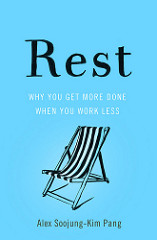
Add REST: WHY YOU GET MORE DONE WHEN YOU WORK LESS to your Goodreads shelf

My books on Goodreads
 The Distraction Addiction: Getting the Information You Need and the Communication You Want, Without Enraging Your Family, Annoying Your Colleagues, and Destroying Your Soul
reviews: 78
ratings: 316 (avg rating 3.53)
ratings: 316 (avg rating 3.53)


