Alex Soojung-Kim Pang, Ph.D.

I study people, technology, and the worlds they make

Month: August 2012

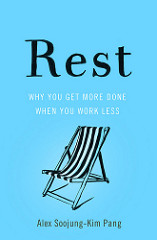
Book cover!

Here’s the cover for the contemplative computing book:


via flickr

Little, Brown spent a lot of time on it, and I think they’ve managed to communicate a lot in a very small, challenging medium. They were also really good about explaining the design choices, making clear that they thought worked, and accommodating those changes I thought would improve it (or explaining why they would be hard to implement).

So the machine chugs along, and we get one step closer to having a finished book on the shelves!


“Articles and ideas are only as good as the fees you can get for talking about them.”

The one problem with writing a book for users, taking a Buddhist-inflected approach to information technologies that emphasizes how people can take back control of their minds, is that I’m less likely to get onto this kind of gravy train:

Ferguson’s critics have simply misunderstood for whom Ferguson was writing that piece. They imagine that he is working as a professor or as a journalist, and that his standards slipped below those of academia or the media. Neither is right. Look at his speaking agent’s Web site. The fee: 50 to 75 grand per appearance. That number means that the entire economics of Ferguson’s writing career, and many other writing careers, has been permanently altered. Nonfiction writers can and do make vastly more, and more easily, than they could ever make any other way, including by writing bestselling books or being a Harvard professor. Articles and ideas are only as good as the fees you can get for talking about them. They are merely billboards for the messengers.

That number means that Ferguson doesn’t have to please his publishers; he doesn’t have to please his editors; he sure as hell doesn’t have to please scholars. He has to please corporations and high-net-worth individuals, the people who can pay 50 to 75K to hear him talk. That incredibly sloppy article was a way of communicating to them: I am one of you. I can give a great rousing talk about Obama’s failures at any event you want to have me at.

What’s so worrying about this trend is that Niall Ferguson, once upon a time, was the best. I’m one of the few people who has actually read his history of the Rothschilds, The World’s Banker, all 1,040 pages of the thing, and it is brilliant, a model of archival research. I find it fantastically depressing that the man who could write that book could end up writing a book like Civilization or an article with just as much naked silliness as the Newsweek cover.

I feel very much the same way about Victor Davis Hanson, a man whose military history is really absolutely first-rate, whose The Other Greeks fairly exploded with insight into Greek society and philosophy, but who’s been mailing in sloppy, thoughtless pieces ever since he left the farm for The Farm. Sad.

“we feel too little of those creative emotions from which a good life springs”

From the conclusion of Bertrand Russell’s 1948 BBC Reith Lectures on “Authority and the Individual” (mp3, or transcript):

We know too much and feel too little. At least we feel too little of those creative emotions from which a good life springs. In regard to what is important we are passive; where we are active it is over trivialities.

Word.

“selling cookie-cutter visions of the future one paperback, slogan, and consulting gig at a time”

Evgeny Mozerov's review of several new TED books— pamphlets, really- is one of the greatest things I've read in a long time. You know you're in for a wild ride when the opening paragraphs starts like this-

Only the rare reader would finish this piece of digito-futuristic nonsense unconvinced that technology is—to borrow a term of art from the philosopher Harry Frankfurt—bullshit. No, not technology itself; just much of today’s discourse about technology, of which this little e-book is a succinct and mind-numbing example.

-and then gets vicious.

Most of the review focuses on Parag and Ayesha Khanna's ebook Hybrid Reality. Apparently the Khannas accidentally once ran over Morozov's dog in their Range Rover, and didn't stop because they were too busy dishing dirt to News of the World about Morozov's mother. Or so I gather, because nothing less would explain the review.

Remember the creatures in Aliens who bleed concentrated acid? Tha's what comes to mind when you read this.

It's. Fabulous.

[A]ll the features that the Khannas invoke to emphasize the uniqueness of our era have long been claimed by other commentators for their own unique eras…. What the Khannas’ project illustrates so well is that the defining feature of today’s techno-aggrandizing is its utter ignorance of all the techno-aggrandizing that has come before it. The fantasy of technology as an autonomous force is a century-old delusion that no serious contemporary theorist of technology would defend.

What's it say about TED? Nothing good, I'm afraid:

I spoke at a TED Global Conference in Oxford in 2009, and I admit that my appearance there certainly helped to expose my argument to a much wider audience, for which I remain grateful. So I take no pleasure in declaring what has been obvious for some time: that TED is no longer a responsible curator of ideas “worth spreading.” Instead it has become something ludicrous, and a little sinister.

Though I have to confess that it felt like he was getting dangerously close to describing som eof the work i've done with this paragraph:

[O]ne can continue fooling the public with slick ahistorical jeremiads on geopolitics by serving them with the coarse but tasty sauce that is the Cyber-Whig theory of history. The recipe is simple. Find some peculiar global trend—the more arcane, the better. Draw a straight line connecting it to the world of apps, electric cars, and Bay Area venture capital. Mention robots, Japan, and cyberwar. Use shiny slides that contain incomprehensible but impressive maps and visualizations. Stir well. Serve on multiple platforms.

And the bit about how the Parangs and Tofflers are both "fast-talking tech-addled couple[s] who thrived on selling cookie-cutter visions of the future one paperback, slogan, and consulting gig at a time" sounds like a kind of a good gig. If you can do it in a more intellectually responsible way, of course.

© 2017 Alex Soojung-Kim Pang, Ph.D.

Theme by Anders NorenUp ↑