Alex Soojung-Kim Pang, Ph.D.

I study people, technology, and the worlds they make

Page 2 of 520

Do kids’ over scheduled lives crowd out grandparents?

My son was at a rugby tournament today (a Sunday), at a field that was a couple hours’ drive. So when I came across this piece by Louis M. Profeta I took notice:

Some years back, I wrote a piece that went viral, “Your Kid and My Kid Are Not Playing in the Pros,” and I got more than a thousand e-mails about the article. Most were supportive, some not, but what I was completely unprepared for was the correspondence I received from grandparents. For the most part, they were all absolutely heartbreaking. The central theme was that they did not know their grandchildren because travel sports had robbed them of weekends and Sunday night dinners and countless other opportunities to interact. Going to their baseball games in the middle of the summer — or sitting in a loud gym — was just not a bonding experience for them; it was physically exhausting. Besides, you can’t talk about rationing sugar during the war, or marching on the mall, or sitting through the Watergate hearings between timeouts. It doesn’t work like that, that’s not enough.

I’ve had plenty of Saturdays or Sundays where I was in the car for hours with kids, but the piece makes me wonder to what degree overscheduling kids’ lives comes at the expense of extended family. In these very highly scheduled lives, do we deepen horizontal connections with teams and interest groups but unintentionally weaken connections between generations?

When you serve the dogs dinner but forget dessert

Apparently tonight’s menu was incomplete, because my English Labrador dove through the recycles until he found a discarded ice cream container.

Moments in the life of Davis

Fortunately it was empty.

Social media, populism, and Charlie Gard

Ranjana Das, a senior lecturer at Surrey University, is looking at the way social media was used in the Charlie Gard case, and has an interesting post on “Social media and Charlie Gard: populism versus public services?“.

The social media furore around the Gard case has been startling, and offers much to reflect on, in terms of the kind of public discussion and debate that has occurred around medical ethics, healthcare and the very role of the NHS in British public life. By employing some classic markers of populism, the ‘army’ has demonstrated a kind of ‘networked populism’ which has co-opted evidence-based debate into the territory of heightened, emotive responses between and across strangers. These have ranged from genuine anguish and expressions of sorrow, to the use of terminology from the Third Reich to characterise doctors, lawyers and clinicians, and to displaying overwhelming emotions of feeling at one with and attached to the real-time tweeting of court hearings, almost as though these were televisual narratives unfolding.

For an American, part of what’s interesting and puzzling about this case is how “Charlie’s Army” came to turn on the NHS, and talk about it as an unaccountable elite ignoring the will of the people, as opposed to an institution that’s central to the postwar British state and social contract between the UK and its subjects- a very “populist” institution.

Roger Cohen and Michael Lewis on deconstructing the administrative state

Washington Monument and Capitol

Two pieces caught my eye today about the current state of the government, and how the administration, when it’s not walking away from its latest rage-induced self-harm, is doing real damage to our institutions and the expertise they contain.

First, in the New York Times, Roger Cohen writes about “The Desperation of Our Diplomats:”

An American jewel is at stake, a place where honorable patriots take an oath to the Constitution — that is to say, to the rule of law, representative governance and the democratic processes that, with conspicuous failings but equally conspicuous bravery, United States diplomats have sought to extend across the world. They have done so in the belief that humanity, in the long run, will benefit from freedom. Since 1945, liberty has extended its reach. But now, at a time of growing great-power rivalry, a diminished State Department leaves a vacuum Russia and China will fill.

Second, Vanity Fair has a long piece by Michael Lewis about what’s happening to the Department of Energy under Rick Perry, who seemed surprised to discover that the DOE mainly does stuff with nuclear weapons, not oil exploration:

Donald Trump’s secretary of energy, Rick Perry, once campaigned to abolish the $30 billion agency that he now runs, which oversees everything from our nuclear arsenal to the electrical grid. The department’s budget is now on the chopping block. But does anyone in the White House really understand what the Department of Energy actually does? And what a horrible risk it would be to ignore its extraordinary, life-or-death responsibilities?

The piece makes a couple things really clear. DOE deals with some incredibly hard and technically complicated issues, and has attracted people competent to deal with them- but the current administration seems to barely care about the world’s nuclear problems (except for North Korea, which they want to outsource to China, since we’ve outsourced so much else to them). Second, there are big problems that have traditionally been hard for anyone to get a grasp on, that the administration is likely to ignore or make worse.

I’ve long liked Michael Lewis, and thought his reporting on the aftermath of the financial crisis was one of the only good things to come from the meltdown. So I’m a little worried that someone who’s so good about writing about catastrophes caused by a mix of greed, hubris, self-interested short-sightedness, that play out in a way to does virtually no harm to those who created it but great harm to everyone else, is now writing about the state of the federal government.

Then again, maybe it’ll be Moneyball Michael Lewis writing, and it’ll turn into an uplifting story about how a bunch of rebels and misfits changed the game. But I doubt it.

My new writing desk

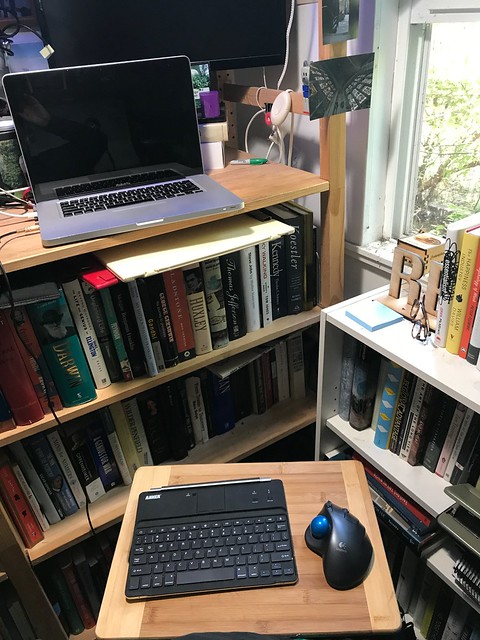
In my garage office I have a standing desk (actually a shelf in my Ikea bookcase). Most of the time it’s awesome, but sometimes I do like to sit down. To support this I’ve slowly added wireless devices that I can use while sitting- a repurposed keyboard from an iPad, and a trackball. Today, I discovered the perfect lap desk to put them on: a bamboo cutting board, liberated from the kitchen.

New lap desk: a bamboo cutting board from the kitchen.

It’s just the right size, and if I end up being both more productive and a little hungrier, I can live with that.

Do spiders have extended minds?

For years I’ve been fascinated by the “extended minds” thesis, the claim that we should regard our minds not as confined to our brains, but including brains, bodies and technologies. (Andy Clark, author of Natural Born Cyborgs, is one influential exponents of the concept.) It’s an idea that guided my book The Distraction Addiction: my contention that we shouldn’t regard technologies as inherently dehumanizing, but instead should be see the best of them as tools we use to become better versions of ourselves, builds on the idea of extended minds.

So I clicked pretty quickly when I saw an article titled “Does a Spider Use Its Web Like You Use Your Smartphone? on The Atlantic Web site. It turns out that for almost the last decade, Brazilian biologist Hilton Japyassú has been conducting experiments on spiders, learning how they use their webs to sense the world and solve unfamiliar problems. He and a colleague now argue that “a spider’s web is at least an adjustable part of its sensory apparatus, and at most an extension of the spider’s cognitive system.”

The whole article, which touches on octopus cognition, other spider species, and Haller’s Rule, is worth reading.

And here’s the abstract from the essay “Extended Spider Cognition” by Hilton Japyassú and Kevin Laland:

There is a tension between the conception of cognition as a central nervous system (CNS) process and a view of cognition as extending towards the body or the contiguous environment. The centralised conception requires large or complex nervous systems to cope with complex environments. Conversely, the extended conception involves the outsourcing of information processing to the body or environment, thus making fewer demands on the processing power of the CNS. The evolution of extended cognition should be particularly favoured among small, generalist predators such as spiders, and here, we review the literature to evaluate the fit of empirical data with these contrasting models of cognition. Spiders do not seem to be cognitively limited, displaying a large diversity of learning processes, from habituation to contextual learning, including a sense of numerosity. To tease apart the central from the extended cognition, we apply the mutual manipulability criterion, testing the existence of reciprocal causal links between the putative elements of the system. We conclude that the web threads and configurations are integral parts of the cognitive systems. The extension of cognition to the web helps to explain some puzzling features of spider behaviour and seems to promote evolvability within the group, enhancing innovation through cognitive connectivity to variable habitat features. Graded changes in relative brain size could also be explained by outsourcing information processing to environmental features. More generally, niche-constructed structures emerge as prime candidates for extending animal cognition, generating the selective pressures that help to shape the evolving cognitive system.

“To get into elite colleges, one must train for standardized tests with the intensity of an athlete”

Dylan Hernandez has an excellent piece in the New York Times about class and the SATs. Hernandez grew up in Flint, Michigan, in a working-class family, and talks about spending time in a summer program at Phillips Exeter.

His classmates that summer were in the main from families that were far better-off, and were “impossibly sporty, charming and intelligent, with perfect smiles and impeccably curated Instagram profiles,” as well as “truly interesting people.” But he was surprised to find that they were also serious SAT grinds:

The majority of low- and middle-income 11th graders I know in Michigan didn’t even sit for the preliminary exams. Most took the SAT cold. Few were privy to the upper-middle-class secret I discovered that summer: To get into elite colleges, one must train for standardized tests with the intensity of an athlete….

Don’t get me wrong. My newfound friends worked extremely hard, but they also seemed to have access to a formula for success that had been kept from the rest of us. It just wasn’t something our overworked guidance counselors could teach.

As a result, all the drilling they did for an exam that is supposed to be an equalizer in ranking students according to raw test-taking skills was only widening the American achievement gap.

This seems to me a pretty accurate reflection of the way advantage and merit work in America today: most kids from advantaged backgrounds work hard to leverage the benefits of their upbringing; but they still enjoy those advantages.

“Alabama senate votes to allow church to form own police force”

I suppose the most charitable way to spin this is to note that Birmingham does have a history of church bombings…

Alabama senate votes to allow church to form own police force

Lawmakers on Tuesday voted 24-4 to allow Briarwood Presbyterian church in Birmingham to establish a law enforcement department.

The church says it needs its own police officers to keep its school as well as its more than 4,000 person congregation safe.

Enough with the ironic Trump voter stories

Alexandra Petri has a great summary of “Every story I have read about Trump supporters in the past week” in the Washington Post:

Next to her sits Linda Blarnik. Like the rusty hubcaps hanging on the wall behind her, she was made in America 50 years ago, back when this town made things, a time she still remembers fondly. She says she has had just enough of the “coastal elitist media who keep showing up to write mean things about my town and my life, like that thing just now where you said I was like a hubcap, yes you, stop writing I can see over your shoulder.” Mournfully a whistle blows behind her, the whistle of a train that does not stop in this America any longer.

Much as I appreciated the first couple articles in this genre, I’m getting pretty weary of them, and coming to see them as really pretty problematic.

DSCF6876

First, they look like investigation, but they’re really condescension. Reporters who a year ago (and ten years ago) should have gone to rural Pennsylvania, or the former factory town in Ohio, or that corner diner in Kansas, are finally doing their jobs — or so it seems. But too easily the pieces fall into condescension, and turn into stories about people being hurt by the person they thought would save them. The stories could all be headlined,

Local Man’s Fate Feeds Our Confirmation Bias About His Political Stupidity

Second, they reduce politics to a narrow set of transactions: I vote for you, you give me a bridge contract, or a job, or deport my Spanish-speaking neighbors (but not the decent one who owns the factory, he’s okay.) Contrast this with the high idealism of Clinton supporters, casting their votes to shatter that final glass ceiling, and make America even greater.

My old elementary school

Finally, they unintentionally reflect a world-view that is very, very Trumpian: they turn politics into the pursuit of personal gain, the satisfaction of tribal grievances, and the narrowing of a vision of America. These stories only work as irony (or tragedy) if the authors accept the premise that politics is about making great deals, not the expression of ideals.

But sometimes people vote to express their ideals, not to maximize their short-term interests. People with teenage sons in 1944 who voted for FDR probably weren’t hoping that their sons would be killed; but they recognized the dangers of fascism, and that its destruction was important. When people choose to make sacrifices for the long-term benefit of groups, or when they accept the burdens of doing things like defending their country, they’re not being saps.

And even if you enjoy stories of voters being hurt by the people they elected, you need to ask how the experience is going to affect their choices next time. Don’t take for granted that Linda Blarnik will switch parties next time; worry that her next vote will go to someone who promises to make Trump look like an scion of the Establishment.


Vision and the movement of fish from water to land

Specimens at the California Academy of Sciences
Not a land-dwelling fish, by the way. Just a cool picture.

Ed Yong in The Atlantic writes about new research on the relationship between the evolution of vision and the movement of fish from water to land. Scientists have long known that some species of fish started hanging out near the shore, then venturing on land, and eventually living on land full-time, starting about 385 million years ago. During this process, Yong writes, “their flattened fins gradually transformed into sturdy legs, ending in feet and digits. Rather than paddling through water, they started striding over solid ground.”

Naturally the evolution of legs has gotten lots of attention among paleontologists, but in a new article, a team led by Northwestern University professor Malcolm MacIver argues that changes in vision played a very significant role in the transition, too. Continue reading

« Older posts Newer posts »

© 2017 Alex Soojung-Kim Pang, Ph.D.

Theme by Anders NorenUp ↑